

What if Sagres’s greatest historical story isn’t that it began Portugal’s Age of Discovery, but that its cliffs have carried meaning for centuries? The sagres portugal history story starts with a landscape ancient writers associated with Promontorium Sacrum, or Sacred Promontory, long before Prince Henry’s maritime ambitions made this Atlantic edge famous.
It’s easy to see why visitors connect Sagres with exploration. Yet the familiar tale of a formal “School of Sagres” doesn’t match the evidence: historians describe a gathering of maritime knowledge, not a documented school building. Look closer, and the headland reveals a richer past shaped by geography, faith, seafaring and local life.
This guide puts Sagres in context and helps you read its landmarks with fresh eyes, from the Fortaleza de Sagres and its 16th-century church to the mysterious stone wind rose. You’ll find ways to distinguish documented history from legend and understand how the coastline shaped the story. If you’d like a local perspective, a knowledgeable guide can connect these places to the wider Algarve landscape.
Key Takeaways
- Understand how Sagres’s position on Portugal’s southwestern coast shaped its maritime connections and enduring significance.
- Explore sagres portugal history with a clearer distinction between documented links to Henry the Navigator and later simplified stories.
- Compare key heritage sites and coastal landmarks, and check current access details before planning your visit.
- Choose a visit sequence around your interests, whether you’re drawn to maritime heritage, religious history or the Atlantic landscape.
- See how local interpretation can connect Sagres’s landmarks with the wider region, including through Geographic Algarve’s Southwest Coast, Lagos and Sagres Tour.
Sagres Portugal history begins with its Atlantic setting
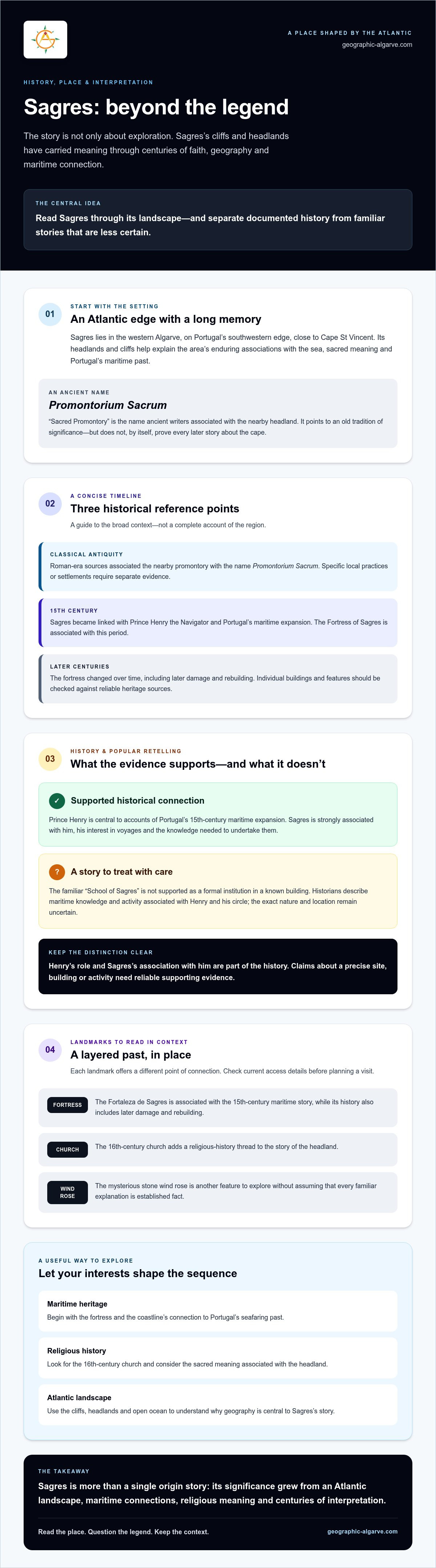
Sagres is a coastal town in the Algarve, shaped by its position at Portugal’s southwestern edge, where the land meets the open Atlantic. Its cliffs and headlands help explain why the area became associated with the sea, religious meaning and Portugal’s maritime past. To understand sagres portugal history, start with the setting: geography is part of the story, not just a dramatic backdrop.
Sagres’s historical significance lies in how its Atlantic edge shaped ideas of the sacred, the strategic and the maritime, not in being the sole birthplace of Portuguese exploration.
Where Sagres sits on Portugal’s southwestern edge
Sagres lies in the western Algarve, close to Cape St Vincent, the prominent headland just southwest of the town. From the coast, the scale of the ocean and the steep cliffs make the area’s maritime associations tangible. Ancient writers referred to the promontory as Promontorium Sacrum, or “Sacred Promontory,” reflecting the significance later attached to this striking landscape. The name offers historical context, but it doesn’t prove every story told about the cape.
A concise timeline of Sagres history
Use this short timeline to separate broad historical context from claims that need closer checking. The dates are reference points, not a complete account of the region.
- Classical antiquity: Roman-era sources associated the nearby promontory with the name Promontorium Sacrum. This establishes an ancient tradition of reverence for the headland, but specific local practices or settlements require separate evidence.
- 15th century: Sagres became linked with Prince Henry the Navigator and Portugal’s maritime expansion. The Fortress of Sagres is associated with this period; its history also includes later damage and rebuilding, so distinguish the site’s development from a single founding moment.
- Later centuries: The fortress continued to change, reflecting the strategic value attributed to this exposed coast. When exploring specific buildings or features, check individual dates and attributions against heritage sources.
The famous “School of Sagres” needs particular care. It’s often presented as a formal institution, but historical interpretation describes a hub for maritime knowledge rather than a school in a known building. Keep that distinction in mind as you explore: the landscape and surviving landmarks are real, while some familiar explanations remain debated or simplified.
How Sagres became linked to Portugal’s maritime history
Sagres’s place in Portugal’s maritime story is closely tied to Prince Henry the Navigator, whose support for voyages and nautical learning helped shape the country’s expansion by sea. But the connection is more nuanced than the familiar image of a single prince directing exploration from a school at Sagres. The history points to influential patronage and a wider network of seafarers and specialists, not one origin point for every Portuguese voyage.
Henry the Navigator and Sagres: what can be established?
Henry is a central figure in accounts of Portugal’s 15th-century maritime expansion, and Sagres is strongly associated with his name. Historical summaries describe his interest in voyages and the knowledge needed to undertake them. One account says he assembled a team of experts in areas such as navigation and cartography. This supports a connection to maritime learning, but it isn’t proof that every expert worked at one fixed site in Sagres.
Keep the distinction clear: Henry’s historical role and Sagres’s association with him are part of the story. Claims about his personal presence, buildings or activities at a precise location need reliable supporting evidence. Popular retellings aren’t the same as documented records.
The navigation-school story: evidence and uncertainty
The “School of Sagres” is a familiar label, but it can give the wrong impression of a formal institution in a known building. The historical picture is better understood as maritime activity and knowledge-sharing associated with Henry and his circle. The exact nature and location of that activity remain uncertain, so avoid presenting them as settled details.
The evidence links Henry and Sagres to Portugal’s maritime ambitions, while the famous school is a simplified story, not a confirmed institution with an established site.
This distinction makes the sagres portugal history narrative more useful, not less compelling. It shows how a place can acquire lasting historical meaning through people, patronage and later retellings, even when a popular landmark story needs qualification. At the fortress, look at what the site itself can show, then separate its physical history from claims about a school or a single command centre.
To explore the wider landscape alongside its maritime associations, consider Geographic Algarve’s Southwest Coast, Lagos and Sagres Tour. A local guide can connect places and regional context without turning debated interpretations into certainties.
What Sagres landmarks reveal about its layered past
Sagres’s landmarks bring together stories of defence, faith and the Atlantic coast. They’re connected by geography, but they don’t all tell the same history. The fortress offers traces of construction and changing use; Cape St Vincent carries both an ancient name and the force of its exposed landscape. Consider each place on its own before looking at their shared regional context.
| Place | Historical association | What to look for | Verification note |
|---|---|---|---|
| Sagres Fortress | Associated with Prince Henry and Portugal’s maritime era; developed and altered over time. | The 16th-century Igreja de Nossa Senhora da Graça and the large stone Rosa dos Ventos, about 43 metres across. | The wind rose’s original purpose is unknown. Check current opening and access details before visiting. |
| Cape St Vincent | A prominent headland linked to the ancient name Promontorium Sacrum, or Sacred Promontory. | The Atlantic-facing cliffs and headland, which help explain the cape’s enduring symbolic pull. | As of June 2026, the lighthouse building, courtyard and interior museum were closed to visitors; the surrounding headland remained accessible. Confirm current status before setting out. |
Sagres Fortress and its changing history
The fortress is commonly associated with the 15th-century maritime era, but its visible features reflect more than one period. The church dates to the 16th century, while the Rosa dos Ventos is a striking stone design uncovered in the 20th century. Its compass-like form invites interpretation, but its purpose hasn’t been established. Notice how the land-facing wall contrasts with the steep cliffs along the other sides, then check official site information for current access.
Cape St Vincent in history and memory
Cape St Vincent is close to Sagres, but it’s a distinct place with its own story. Its ancient association with sacred meaning belongs to the cape’s long cultural memory; it shouldn’t be treated as proof that every later maritime event or legend happened there. The cliffs provide geographic context, while specific historical claims need evidence tied to the event and location.
That distinction makes sagres portugal history richer than a single tale of exploration. Religious associations, maritime activity and regional traditions overlap across the landscape, but they remain different strands. For a wider view of how place and tradition shape the Algarve, explore Algarve cultural heritage and local traditions.
How to explore Sagres history through its places
A little planning can turn a visit to Sagres into more than a series of scenic stops. Start with the story you’re most curious about, then use a map to connect the relevant landmarks with the coastline around them. This gives you a clearer sense of how maritime ambitions, religious associations and local geography relate, without assuming every story belongs to the same place.
Build a history-focused visit around your interests
Choose a starting point based on the perspective you want. These options are a planning framework, not a fixed itinerary: opening times, access and conditions can change.
- For maritime history: Begin with Sagres Fortress. Read the site’s current interpretation and consider how its position relates to the surrounding coast.
- For heritage: Focus on the fortress’s built features and religious history. Check which dates and attributions are supported by the site’s information.
- For coastal context: Use a map to place Sagres and Cape St Vincent in relation to one another. The landscape helps explain the region’s maritime associations, but events at one location shouldn’t automatically be assigned to the other.
Before setting out, check opening details and access directly with each site. The fortress and cape have different visitor arrangements, so verify them separately. A current map and reliable heritage interpretation can help you understand distances and links between places without treating them as one continuous historic site. For broader regional ideas, see this Southwest Coast Portugal tour guide.
Make historical interpretation easier on site
As you explore, sort what you read and hear into three categories: documented details, debated interpretations and legend. This makes the sagres portugal history story easier to follow, especially when familiar accounts sound more certain than the evidence allows. Check current displays, notices and official site updates before your visit, and look for sources that distinguish established dates from later retellings.
Want help connecting individual landmarks with the wider Algarve landscape? Consider Geographic Algarve’s Southwest Coast, Lagos and Sagres Tour for local interpretation of the region’s cultural and natural context.
Discover Sagres history with a knowledgeable local guide
Knowing the names of Sagres’s landmarks is a good start. Understanding how they relate to the Atlantic landscape and the wider Algarve takes another kind of attention. A knowledgeable local guide can add regional context, explain which stories are supported by evidence and flag where popular retellings simplify the past. That perspective helps make sagres portugal history feel connected to a living place, not just a set of dates.
What a local perspective adds to Sagres history
At a historic site, details can prompt useful questions: what is documented, what remains uncertain, and what has become part of local memory? A guide can help keep those threads distinct while showing how the coastline, heritage sites and regional traditions contribute to Sagres’s identity. The aim isn’t to turn every view into a historical claim. It’s to notice how landscape and human stories meet while respecting the limits of what can be established.
Geographic Algarve describes its approach as ethnocultural geography, bringing cultural and nature-based perspectives to excursions in the Algarve. Founded and managed by local expert Vasco Salgueiro, the company has more than 25 years of experience and works with multilingual local guides. Local knowledge and careful interpretation offer a way to understand the region’s heritage alongside its natural setting.
Continue exploring the Algarve with Geographic Algarve
For visitors who want local context as part of a wider regional experience, Geographic Algarve offers the Southwest Coast, Lagos & Sagres Tour. It may suit visitors interested in exploring Sagres in relation to nearby places and landscapes. Check the current tour details to see what’s included and whether it fits your interests; don’t assume a particular landmark visit or historical interpretation unless the details confirm it.
A local guide can enrich a visit, but it’s also possible to explore independently using reliable site information and a little preparation. Choose the approach that fits your plans, and leave room for questions that arise when you encounter the places themselves. If guided local context appeals to you, explore Geographic Algarve’s guided experiences and review the current details before deciding.
See Sagres with fresh historical perspective
Sagres makes more sense when you read its landmarks alongside the Atlantic landscape. Its maritime associations are significant, but the familiar “School of Sagres” story shouldn’t be treated as settled fact. Distinguishing documented history from later legend lets you appreciate the place without flattening its complexity.
Keep two ideas in mind as you plan: the fortress and Cape St Vincent have distinct histories, and their geography helps explain why Sagres holds such a powerful place in Portugal’s story. A map, current site information and thoughtful local interpretation can bring those connections into focus. That’s the value of exploring sagres portugal history through both its places and their wider regional context.
Geographic Algarve’s cultural and nature-based excursions include the Southwest Coast, Lagos and Sagres Tour. Founded and managed by local expert Vasco Salgueiro, the company brings more than 25 years of experience and multilingual local guides to its regional interpretation. Review the current tour details, then explore Geographic Algarve’s guided experiences if a local perspective suits your plans.
Let the coastline, heritage and carefully examined stories shape your visit. Sagres has plenty more to reveal when you know what to look for.
Frequently Asked Questions
What is Sagres in Portugal famous for historically?
Sagres is known for its Atlantic setting, its association with Prince Henry the Navigator and Portugal’s maritime expansion, and the historic fortress nearby. Ancient sources also associated the cape with Promontorium Sacrum, or Sacred Promontory. Together, these connections make sagres portugal history a story of geography, maritime ambition and religious meaning, rather than a single event or a claim that exploration began in one place.
Was there really a navigation school in Sagres?
There’s no firm evidence of a formal navigation school in a specific Sagres building. The familiar “School of Sagres” story is better understood as shorthand for maritime knowledge and activity associated with Prince Henry and his circle. Historical accounts describe a broader network of people and expertise, rather than a confirmed institution with established premises. Treat claims about the school’s exact location or structure as uncertain unless supported by reliable evidence.
What was Henry the Navigator’s connection to Sagres?
Prince Henry the Navigator is linked to Sagres through his role in Portugal’s 15th-century maritime ambitions and the history associated with the fortress. Accounts describe his support for voyages and maritime knowledge, including expertise needed for navigation. However, details of his personal presence at a specific site, or of particular buildings connected to him, need careful sourcing. His historical importance doesn’t prove every popular story about Sagres is fact.
Why is Sagres Fortress historically important?
Sagres Fortress is an important landmark associated with Prince Henry and Portugal’s maritime era, though its history includes later changes and rebuilding. Visitors can see the 16th-century Igreja de Nossa Senhora da Graça and a stone wind rose about 43 metres in diameter. Its original purpose is unknown. The fortress’s position also helps explain its defensive character, with cliffs forming natural barriers along much of its edge.
What is the historical significance of Cape St Vincent?
Cape St Vincent is a prominent headland near Sagres, associated in ancient sources with the name Promontorium Sacrum, or Sacred Promontory. Its dramatic Atlantic setting contributed to its lasting symbolic significance. The cape and Sagres Fortress are nearby but distinct places, so don’t assume events linked to one occurred at the other. Visitor access can change, so check current information about the headland and lighthouse before setting out.
Can you explore Sagres history in one day?
Yes, a day can give you a useful introduction if you focus on the places that match your interests. You might prioritise the fortress for built heritage, then consider the coastal context around Cape St Vincent if access allows. This is a planning idea, not a guaranteed itinerary. Check current opening times, closures and access directly with each site, and allow your plans to follow the information available on the day.
Is Sagres worth visiting for its history?
Yes, especially if you want to connect Portugal’s maritime past with the landscape that shaped Sagres’s identity. The fortress, Cape St Vincent and local heritage offer distinct perspectives, while a guide can help separate documented history from legend. For broader Algarve context, you might also explore Portimão, Lagos, Albufeira, Silves, Lagoa, Carvoeiro, Alvor, Armação de Pêra, Galé, Olhos d'Água and Praia da Luz.

Article by
Kim
To conclude her studies Tourism and Recreation Management, Kim came to Portugal in 2006 for a three month internship and then simply never left! She took a few years exploring the country, living in Porto and the Algarve, while gaining experience working for the main international tour operators. Since 2013 she is a full-time local guide for Geographic Algarve, where she can share her love for and knowledge of Portugal in the best way. Both on tour and here in the blog, she shares crucial tips to get the most out of your stay in the Algarve. Kim creates her articles and photos with the help of AI, so she has more time left to show you around in the wonderful Algarve!
Disclaimer - AI generated content
This article was created by AI (including photos), within guidelines set by Geographic Algarve. Geographic Algarve checks to the best of her abilities all articles for incongruencies, but may not succeed to correct all inaccurate details before publishing. In no way or form, are these articles part of any contract when booking one of our trips. Only the specific tour information as stated on www.geographic-algarve.com is valid. In case of any doubt, please contact us via [email protected].


