
A strong educational itinerary connects Portugal’s history and culture with landscapes students can explore firsthand. Many Portugal study tours start in Lisbon and continue south to the Algarve, where students can investigate historic towns, coastal heritage and natural areas. Educational tours for students in the Algarve bring these themes together in a focused regional excursion.
Planning a school or college trip means balancing curriculum goals with the practical value of each stop. A memorable visit should offer more than a list of landmarks: it should help students connect local traditions, geography and environmental heritage with their studies.
Explore ways to shape a Portugal itinerary, Algarve landmarks and natural sites to consider, and educational excursion ideas for school and college groups. Match the trip to students’ interests, from cultural heritage in Silves to the landscapes of the southwest coast.
Key Takeaways
- Match each stop to a learning objective, then shape the itinerary around the subject students will explore in the field.
- Use Algarve landmarks and natural sites to connect local history, cultural traditions and environmental themes.
- Plan school and college excursions with activities that invite observation, discussion and reflection, not just sightseeing.
- Explore guided regional options to find an itinerary that fits your group’s interests, from coastal heritage to inland towns.
Portugal educational tour itineraries
Build a Portugal itinerary around one clear learning goal, such as history, language or coastal geography. Most Portugal educational tours start in Lisbon, the country’s capital and largest city. Belém Tower, built in the early 16th century, offers a focused starting point for discussing maritime history. Castelo de São Jorge adds another layer, with more than a thousand years of history to explore.
For a north-to-south route, connect destinations by theme rather than trying to cover every landmark. A class could begin in Lisbon, continue through central Portugal, then finish in the Algarve with coastal and cultural study. Sintra’s National Palace of Pena, associated with 19th-century Portuguese royalty, offers a distinct contrast to Lisbon’s older fortifications. In the Algarve, students can explore how local traditions and landscapes shape regional identity.
Language study can add another dimension to the itinerary. Pair Portuguese lessons with practical activities, such as identifying place names or learning greetings before a visit. Schools may also combine Portuguese with another language course, using a Portugal and Spain itinerary to compare vocabulary, customs and regional histories. A wider Portugal, Spain and Morocco route can introduce students to different cultural contexts, provided the learning objectives and travel time allow for the additional destinations.
Teachers can book by setting the group’s learning goals, preferred dates, language needs and destinations, then shaping those details into a guided itinerary. Plan international school tours 12 to 18 months in advance to allow time for coordination.
For educational tours for students in the Algarve, keep the regional section purposeful. A coastal study might focus on natural heritage, while a visit to Silves can prompt discussion of local history and traditions. Add reflection tasks, such as a short field journal or a comparison of Lisbon and Algarve architecture, to help students connect each destination to the wider Portugal itinerary.
Tours of Algarve landmarks and natural sites
Connect Algarve landmarks with the questions students are studying. Silves Castle offers a starting point for exploring the region’s history and traditions. Monchique introduces a contrasting inland landscape, while Ria Formosa brings coastal environments into focus. At each stop, ask students to record an observation and link it to a classroom theme.
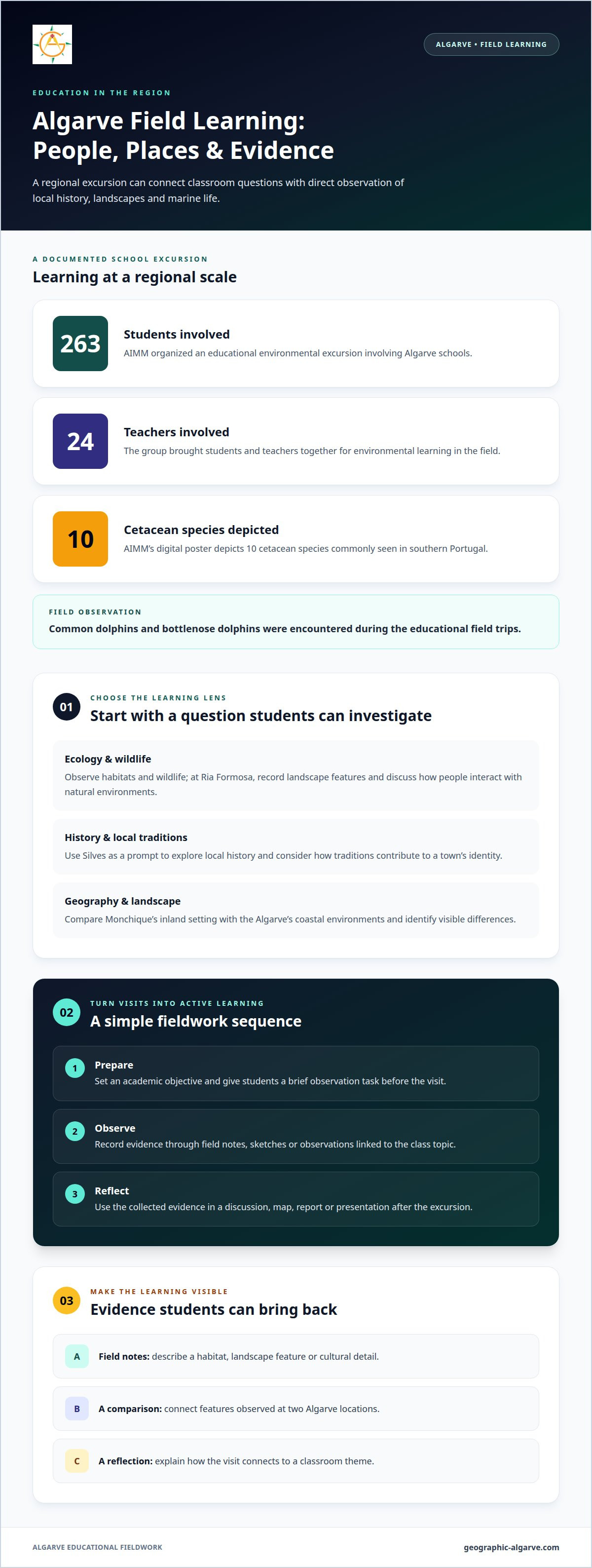
Specialist guides can add context that a short visit alone may miss. At Silves, a guide might connect the castle to local history; at Ria Formosa, students can discuss habitats and human activity. AIMM’s digital poster depicts 10 cetacean species commonly seen in southern Portugal, offering a practical prompt for marine-life observation. Landmark access varies by site: a castle, nature area and coastal viewpoint each present different routes and surfaces.
A student tour can combine guided interpretation, visits to selected sites and learning activities linked to the itinerary. Plan meal breaks and travel between locations around the programme. Students might sketch a site, keep field notes or compare cultural features at two Algarve locations.
Accessibility depends on the places included and individual access needs. Silves Castle’s historic setting and paths at natural sites call for different planning considerations. Build the itinerary around the group’s mobility requirements, choosing suitable sites and allowing time for everyone to take part.
For an international itinerary that also includes Lisbon, connect Algarve fieldwork with cultural landmarks and neighbourhoods such as Alfama and Belém. Students can compare the character of Portugal’s cities with the region’s coastal and inland environments. A guide can help frame those contrasts through history, architecture and local traditions. Explore Algarve cultural and nature itinerary ideas to shape a route around your group’s learning priorities.
Educational excursions for school and college students
Start with an academic objective, then build the excursion around evidence students can observe. A class studying ecology might focus on habitats and wildlife, while a history class could investigate local traditions in Silves. Before the visit, teachers can prepare a brief observation task. Afterwards, students can turn their field notes into a discussion, map or report.
AIMM is one documented organizer of educational environmental excursions with Algarve schools. In May 2024, AIMM organized a tour involving 263 students and 24 teachers. Common dolphins and bottlenose dolphins were encountered during the field trips. This example shows how a regional excursion can connect marine observation with environmental learning for large school groups.
For a useful programme, connect each activity to a question students can answer on site. At Ria Formosa, a class could record landscape features and discuss how people interact with natural environments. In Silves, students could consider how local traditions contribute to the town’s identity. These prompts support active learning without turning the visit into a lecture.
College groups can deepen the academic focus with short interviews, field journals or presentations. Tourism students might examine how cultural heritage shapes a destination; geography students could compare coastal and inland landscapes. For international groups, guided discussion can also create opportunities to practise language skills and share different perspectives.
Which Algarve tour providers offer educational programs for schools? AIMM’s May 2024 environmental tour is a documented example of an organization arranging an excursion with Algarve schools. For other school visits, guided regional operators can help shape an itinerary around the class’s subject, chosen sites and learning activities. Agree on the academic aim first, then select locations and tasks that give students clear material to discuss.
What educational tours for students are available in the Algarve, Portugal?
Algarve excursions can focus on coastal geography, cultural heritage or the relationship between communities and landscapes. A coastal itinerary might use Benagil and Carvoeiro to prompt questions about rock formations and erosion. A cultural route could connect Lagos and Sagres, inviting students to compare the character and history of two coastal towns.
For inland themes, combine Monchique with a heritage stop. Students can record changes in landscape, settlement patterns and local identity as the itinerary moves between locations. In Loulé, a cultural study can explore how the built environment reflects regional life. Keep the route centred on one subject, then give students a short task at each stop.
Nature-focused visits work best with active observation. At a coastal viewpoint, students can sketch landforms and describe what they see. On a nature walk, they can note plants, habitats and signs of human activity. These activities turn a visit into fieldwork without specialist equipment or a lengthy classroom briefing.
To choose an excursion, match the destination to the group’s age, subject and learning goal. Then plan a simple sequence: introduce a guiding question, observe the site and discuss findings afterwards. For example, a geography group could compare coastal and inland landscapes, while a history class could explore how local heritage shapes a town’s identity. A tailor-made route can bring selected Algarve themes together when a standard itinerary does not fit the lesson plan.
Make the learning outcome visible. Ask students to produce a field journal, annotated map or short group presentation after visiting places such as Lagos, Monchique or Loulé. This gives teachers a practical way to connect the excursion with classroom work and helps students retain details from each stop. Plan an Algarve learning itinerary around your group’s subject and chosen sites.
Geographic Algarve: Southwest Coast, Lagos & Sagres Tour
Geographic Algarve’s Southwest Coast, Lagos & Sagres Tour gives school and college groups a guided way to explore coastal landscapes and regional heritage. Choose this tour when students’ learning goals include geography, local culture or the history of Algarve communities. Teachers can connect the visits with field notes, landscape observations and classroom discussion afterwards.
For a different academic focus, the Monchique & Silves Tour brings inland scenery and cultural heritage into view. The Loulé & Ria Formosa Tour connects a historic town with a distinctive natural area. Choose the tour according to the subject students are studying and the sites that best support it.
Share your group’s educational priorities with Geographic Algarve to discuss the guided tour that best fits your itinerary. Contact the team to plan a school or college excursion.
Turn your learning goals into an Algarve itinerary
The strongest educational tours for students in the Algarve begin with a clear classroom objective. Decide what students should notice, discuss or create during the visit, then shape the itinerary around that goal. A field journal, group presentation or set of observations can turn the excursion into lasting academic work.
Geographic Algarve offers the Southwest Coast, Lagos & Sagres Tour, Monchique & Silves Tour, and Loulé & Ria Formosa Tour. Each offers a different regional focus to help teachers match destinations with students’ interests. Share the subject, preferred locations and learning priorities to start planning a suitable excursion.
Take the next step and contact Geographic Algarve to plan a tour. Give students a chance to connect their studies with Portugal’s landscapes and living heritage, and make the excursion a meaningful part of their learning journey.
Frequently Asked Questions
Are you able to arrange guided educational tours and access to Portugal's major historical and cultural institutions?
Geographic Algarve arranges guided cultural and nature-based excursions, with commentary on Portuguese heritage. The tours focus on regional experiences; they don’t promise access to major institutions. For a school programme, teachers can use a guided Algarve visit to explore local traditions, gastronomy or environmental heritage, then plan any institution visits separately around the class’s objectives and itinerary.
What do students learn on a Portugal educational tour?
Students can explore how culture, geography and environmental heritage shape life in Portugal. A class might examine how local food reflects regional identity or discuss how communities relate to nearby natural areas. Ask students to collect examples during the visit, then use them in a short presentation or classroom discussion.
What grade levels are Portugal student tours best for?
Portugal student tours can suit different grade levels when learning tasks match students’ abilities and curriculum. Younger pupils can draw or describe what they observe at a site. Older students can compare regional traditions or develop a short research presentation. Teachers can adjust the discussion and follow-up assignment to suit the class.
What is the best time of year to visit Portugal for a school trip?
Spring and fall can make student travel in Portugal easier to plan around visitor levels. Summer is warm and sunny, especially along the Algarve coast, but busier with tourists. Schools can choose a season based on their preferred balance of outdoor activities, site visits and crowds. The time of year can also influence which learning activities suit the itinerary.
Why book an educational trip to Portugal?
A trip to Portugal gives students a chance to investigate subjects through real places and local perspectives. A class can explore how regional food, cultural practices or natural landscapes connect with topics studied at school. Students can bring their observations back into lessons and use the shared experience as a starting point for further research.
Which Algarve educational tours are best for school groups by age and subject?
Choose an itinerary that gives students clear material for their subject. A coastal-focused group may benefit from the Southwest Coast, Lagos & Sagres Tour, while the Monchique & Silves Tour can suit studies of inland landscapes and heritage. The Loulé & Ria Formosa Tour offers another pairing of town and natural-area themes. Adapt the class activity to students’ age and learning goals.
Article by
Kim
To conclude her studies Tourism and Recreation Management, Kim came to Portugal in 2006 for a three month internship and then simply never left! She took a few years exploring the country, living in Porto and the Algarve, while gaining experience working for the main international tour operators. Since 2013 she is a full-time local guide for Geographic Algarve, where she can share her love for and knowledge of Portugal in the best way. Both on tour and here in the blog, she shares crucial tips to get the most out of your stay in the Algarve. Kim creates her articles and photos with the help of AI, so she has more time left to show you around in the wonderful Algarve!
Disclaimer - AI generated content
This article was created by AI (including photos), within guidelines set by Geographic Algarve. Geographic Algarve checks to the best of her abilities all articles for incongruencies, but may not succeed to correct all inaccurate details before publishing. In no way or form, are these articles part of any contract when booking one of our trips. Only the specific tour information as stated on www.geographic-algarve.com is valid. In case of any doubt, please contact us via [email protected].


