

What if the true spirit of your vacation isn't found on a crowded beach, but inside a sun-drenched workshop tucked away in the Monchique mountains? You likely want more than a generic souvenir. You're searching for a connection that feels genuine, yet finding these hidden rural workshops on your own is a challenge. It's frustrating to see mass-produced items when you know ancient traditions are still alive just a few miles inland.
A professional local artisans tour Algarve transforms your trip into a deep, expert-led journey into the region's soul. You'll meet master artisans in person and finally understand the profound link between the rugged landscape and the crafts it inspires. We'll show you how to navigate the "Hidden Algarve" to support the rural economy directly. With tourism revenue in the region growing by 10.5 percent as of May 2026, now is the perfect time to explore. This guide previews an immersive itinerary where you can experience everything from traditional pottery to intricate tile painting. Get ready to discover the definitive highlight of your entire trip!
Key Takeaways
- Uncover the geological secrets of the Monchique mountains and the Barrocal that have defined Algarvian pottery and clay work for centuries.
- Master the art of spotting genuine craftsmanship by leveraging the 'Red Book of Handicraft Activities' to avoid mass-produced imitations.
- Plan your perfect 2026 heritage route with a seasonal guide to the most authentic workshops in Loulé, Silves, and Olhão.
- Experience the soul of the region through a local artisans tour Algarve, the ultimate way to embrace the growing 2026 slow travel trend.
- Benefit from over 25 years of local expertise to gain exclusive, personal access to hidden rural workshops that remain invisible to the average traveler.
The Living Heritage of the Algarve: Why an Artisan Tour is Essential in 2026
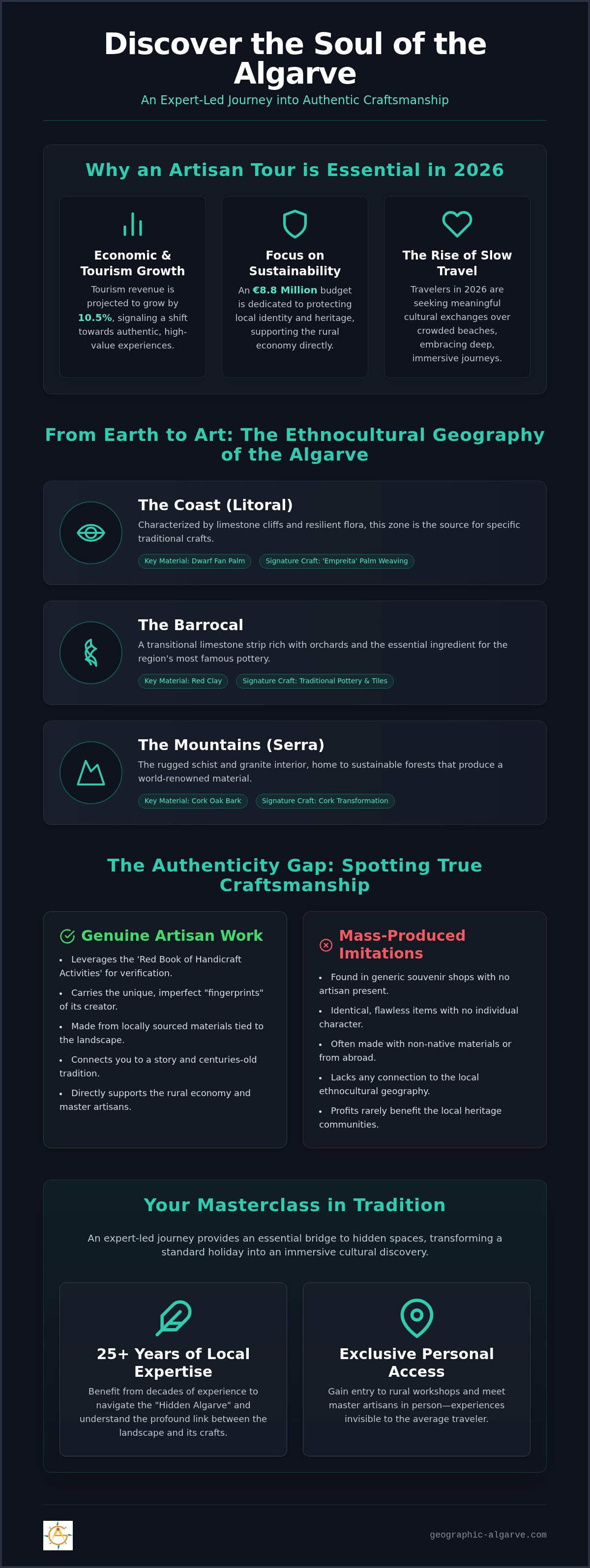
The Algarve is evolving. In 2026, travelers are looking past the golden cliffs to find the region's true soul. A local artisans tour Algarve isn't just a day trip; it's a gateway to ethnocultural geography. This means you aren't just looking at the land; you're understanding how the soil, the plants, and the stones have shaped the lives of people for centuries. While the coast offers sun and sea, the inland Barrocal and the mountains hold the raw, unfiltered history of Portugal. Master artisans act as the guardians of this heritage. They preserve skills that would otherwise vanish in our digital age.
2026 marks a major shift toward slow travel. People want meaningful cultural exchange. The Algarve's 2026 sustainability strategy, backed by an 8.8 million Euro budget, focuses on protecting this local identity. Choosing an expert-led journey ensures your visit supports the rural economy directly. It turns a standard holiday into a premium leisure experience that respects the past while building the future.
Beyond the Souvenir: The Search for Authenticity
Stop buying mass-produced trinkets that were made thousands of miles away. True heritage pieces carry the fingerprints of their creators. Ethnocultural geography in the Algarve is the study of how the physical environment, from limestone hills to cork forests, dictates the materials and methods used in traditional crafts. Witnessing a master potter at work creates an emotional bond that a shop shelf can't provide. You see the effort. You feel the history. This is especially evident at large gatherings like FATACIL, the Algarve's largest craft fair, where the scale of local talent is on full display. Support these masters directly and bring home something with a real story.
The Connection Between Landscape and Tradition
Every authentic craft begins with the earth. The Algarve's Natural Parks are more than just scenic vistas; they are the primary source of raw materials for ancient skills. Cane basketry depends on the riverbanks. Pottery relies on the specific red clay of the Barrocal. Step into a traditional workshop and let your senses lead the way. The sharp, clean scent of fresh wood shavings mixes with the earthy dampness of raw clay and the sweet aroma of dried palm leaves. These workshops are living museums. They offer a masterclass in tradition that connects you directly to the Portuguese landscape. A local artisans tour Algarve provides the essential bridge to these hidden spaces. Don't settle for a surface-level vacation. Dive into the heart of the region and see how the earth itself is transformed into art!
From Earth to Art: The Ethnocultural Geography of Algarvian Crafts
Understanding the Algarve requires looking at its three distinct geographic layers. First, there's the coast with its limestone cliffs and dwarf fan palms. Next, the Barrocal acts as a transitional limestone strip filled with orchards and red clay. Finally, the schist and granite mountains of the Serra form a rugged northern border. A local artisans tour Algarve reveals how these specific environments dictate the materials used in every workshop. From the granite-fed springs of Monchique to the sun-scorched coastal plains, the landscape is the true architect of the region's heritage. Geography isn't just a backdrop; it's the source of the artist's palette.
Cork: The Gold of the Monchique Mountains
The cork oak (Quercus suber) is the backbone of the rural interior. In the Monchique mountains, the harvest follows a strictly sustainable cycle where the bark is stripped every nine years. This process doesn't harm the tree; it allows the forest to thrive for centuries. Skilled harvesters use traditional axes to peel the "gold" from the trunks. This raw material is then transformed into high-fashion accessories and functional art. It's a craft deeply tied to the Southwest coast Portugal tour landscapes, where the ancient forests meet the Atlantic breeze. Witnessing this transformation is a highlight of any expert-led journey into the mountains.
Palm Weaving and Mediterranean Identity
Along the coast, the dwarf fan palm represents the resilience of the local flora. For centuries, artisans have used the 'Empreita' technique to braid dried palm leaves into sturdy strips. These strips are then sewn together to create baskets, mats, and hats. This ancient method is a labor of love that requires patience and precision. These functional pieces aren't just souvenirs; they're symbols of a living Mediterranean identity. Organizations like Loulé Criativo work tirelessly to ensure these skills aren't lost to time by connecting visitors with master weavers. Seeing a weaver's hands move with lightning speed is a masterclass in tradition.
Pottery and Tile: The Red Earth of Silves
Silves was once the Moorish capital of the Algarve, and its ceramic traditions still reflect that rich history. The Barrocal region provides a unique red clay that has been used in kilns for generations. This earth gives Silves pottery its distinct, warm hue and incredible durability. When you discover Algarve cultural tours, you get to see how this raw earth is shaped and fired into beautiful tiles and vessels. It's a visceral experience that links the soil beneath your feet to the finished masterpiece. If you want to experience the soul of the region, we suggest you explore the Monchique & Silves Tour for a deep dive into these ancient kilns!
The Authenticity Gap: Distinguishing True Craftsmanship from Mass Production
Don't let your memories be manufactured in a factory thousands of miles away. The most common fear for travelers is accidentally purchasing a "Made in Elsewhere" trinket while searching for local heritage. A dedicated local artisans tour Algarve acts as your expert shield against these common tourist traps. By visiting the workshops directly, you ensure your investment supports the actual creator and the rural economy. In 2026, authenticity isn't just a buzzword; it's a commitment to the region's survival. You want the real story, and that starts with meeting the person behind the craft.
Buying direct from the source is the only way to guarantee a piece's origin. It creates a transparent link between your purchase and the artisan's livelihood. This direct support is crucial for local sustainability. It provides the financial stability masters need to maintain their workshops in rural areas. When you see a master's hands covered in the red clay of the Barrocal, you know you've found the genuine article. It's an investment in a living history that mass production simply cannot replicate.
Ensuring financial stability is a priority for any small enterprise, whether in the mountains of Portugal or the heart of Texas, where firms like Apex Income Tax & Multiservice LLC provide essential tax and business support to help local entrepreneurs thrive.
The 'Red Book' of Endangered Traditions
The "Red Book of Handicraft Activities" is a vital document that identifies traditions at the brink of extinction. These skills are often held by only a handful of masters in remote villages. Currently, three crafts face a significant risk of disappearing:
- Cane Basketry: The intricate weaving of river reeds into functional storage.
- Esparto Grass Weaving: An ancient technique using tough Mediterranean fibers.
- Tinwork: The manual shaping of metal into traditional lanterns and kitchenware.
Spotting the Genuine Article
How do you tell the difference between a masterpiece and a factory imitation? Use this 3-point visual check for authentic Algarvian pottery:
- Look for the Maker's Mark: Genuine pieces almost always feature a stamped or hand-signed signature on the base.
- Check for Imperfect Symmetry: Hand-thrown clay has tiny, beautiful variations. If a piece is perfectly identical to twenty others, it likely came from an industrial mold.
- Feel the Weight and Texture: Authentic red clay from the Barrocal has a specific density. It should feel grounded and substantial, not hollow or light.
Planning Your 2026 Artisan Route: A Practical Checklist for Heritage Seekers
Planning a local artisans tour Algarve requires more than just a GPS. Many of the region's finest masters work from private home-studios tucked away on unmarked lanes. You need expert local knowledge to open these doors. In 2026, we suggest focusing your journey on the historic hubs of Monchique, Silves, Loulé, and Olhão. Each location offers a unique window into the heritage we explored earlier. Geography dictates the craft, and these towns represent the pinnacle of Algarvian tradition.
Timing your visit is crucial for the best experience. Visit in Spring 2026 to see palm weavers working with pliable, freshly harvested fronds. The natural light in the workshops is spectacular during this season. Autumn is perfect for the cork industry. You can see the raw bark being processed into functional art just as the harvest cycle ends. Regardless of the season, a local artisans tour Algarve ensures you witness these cycles firsthand.
Pack for a productive day in the rural interior. Bring a notebook, a refillable water bottle, and local currency for direct purchases. Many masters in remote villages don't use card machines. Having cash allows you to support the local economy directly without any technical hurdles. This preparation ensures your time is well-spent and your focus remains on the incredible talent of the artisans.
The Essential 2026 Artisan Checklist
- Visit a copper smith in Loulé to see the iconic 'Cataplana' being forged by hand.
- Observe tile painting in Silves, where masters recreate geometric patterns from the Moorish era.
- Find a palm weaver in the Barrocal during the morning hours when the leaves are easiest to handle.
- Explore a cork workshop in the Monchique hills to see bark transformed into premium accessories.
Workshop Etiquette: Respecting the Master
Always ask permission before taking photographs. These workshops are private sanctuaries of creativity. Engage in conversation naturally, but wait for a natural break in the artisan's movements. You don't want to disrupt a delicate brushstroke or a precise chisel cut. The rhythmic tap of a hammer against copper defines the respectful silence of a master at work.
Logistics for the Rural Interior
Digital maps often fail in the winding streets of the Barrocal. Many workshops are located in ancestral homes that simply don't appear on standard apps. A pre-arranged route is the best way to maximize your vacation time. It removes the stress of navigation and guarantees access to the most authentic sites. If you want to skip the planning and meet these masters in person, you should book your private tailor-made tour to experience the region's true soul!
Immersive Cultural Discovery with Geographic Algarve: A Masterclass in Tradition
Geographic Algarve serves as the essential bridge to the region's most secretive workshops. Led by Vasco Salgueiro, our team brings over 25 years of local expertise to every journey. We don't just show you the sights; we decode the landscape through the lens of ethnocultural geography. This professional approach ensures you bypass the generic tourist traps that clutter the coast. Instead, you reach the raw, authentic heart of the Barrocal and the mountains. Our mission is to make your time feel precious and well-spent by providing exclusive access to masters who rarely open their doors to the general public. Experience the region's soul with a partner who understands the deep history of the land.
Our excursions are designed to transform your holiday into a lasting heritage legacy. By connecting you directly with masters of pottery, weaving, and cork, we provide a premium leisure experience that respects the past. You aren't just a spectator in a gallery. You become a vital part of the sustainability effort that protects these ancient skills for future generations. We take pride in the local landscape and aim to inspire confidence in every traveler who seeks the "real" Algarve. Every stop on our route is a masterclass in tradition, curated to maximize your discovery of hidden gems.
Expert-Led Heritage Journeys
Our multilingual local guides provide deep historical context that a standard guidebook simply cannot offer. They act as translators of culture, helping you understand the complex link between the schist mountains and the pottery wheel. We focus on Natural Parks and environmental heritage to show you exactly where the raw materials originate. Every route is carefully curated to support small-scale family businesses directly. We avoid crowded commercial spots to give you a personalized, human connection with the artisan. This organized yet adventurous spirit ensures our excursions remain the definitive highlight of your entire trip!
Securing Your 2026 Heritage Experience
Authentic family workshops have a very limited capacity. These are private sanctuaries, not industrial factories. To ensure your place on a private tailor-made artisan route, we encourage you to book well in advance. 2026 is seeing a significant rise in demand for immersive cultural discovery, with tourism revenue in the region growing by 10.5 percent as of May 2026. Don't miss the chance to witness the "Living Heritage" we've discussed throughout this guide. Take the stress out of planning and let our enthusiasts share the region's hidden highlights with you. A local artisans tour Algarve is more than a walk through history; it's an investment in the future of Portuguese craft.
Book your local artisans tour Algarve with the experts today!
Secure Your Place in the Algarve's Living Legacy
Your journey through the Algarve should be as unique as the red clay of the Barrocal. We've explored how the region's geography dictates its ancient crafts. You now know why identifying genuine heritage is essential for a sustainable future. Don't settle for a generic experience when you can witness the raw power of tradition firsthand. A local artisans tour Algarve is your definitive gateway to the region's most exclusive workshops and hidden masters. Our team brings over 25 years of ethnocultural expertise to every itinerary. We provide exclusive access to hidden rural workshops that remain invisible to the average traveler. Every excursion is built on a foundation of sustainability-focused heritage preservation. It's time to transform your vacation into a meaningful cultural exchange.
Discover the soul of Portugal on a private Local Artisans Tour with Geographic Algarve!
Your adventure into the heart of the Portuguese interior starts now. Join us to create memories that support a living history!
Frequently Asked Questions
Where can I find the most authentic local artisans in the Algarve?
You'll find the most authentic masters tucked away in the rural interior towns of Monchique, Silves, and Loulé. These locations are the heart of the region's heritage. A local artisans tour Algarve bypasses the crowded coastal shops to reach private home-studios in the Barrocal. These artisans rely on the specific geology and flora of their surroundings. This ensures every piece you see is a true expression of the local landscape.
Is it possible to participate in a craft workshop rather than just watching?
Hands-on participation is a major highlight of many heritage journeys. You can book specific sessions for pottery, tile painting, or palm weaving to learn ancient skills directly from a master. These workshops transform you from a spectator into a creator. It's an incredible way to understand the patience and precision required for these crafts. Always check availability in advance as these private sessions fill up quickly!
How do I know if the cork or pottery I buy is actually made in Portugal?
Genuine Portuguese items almost always feature a stamped or hand-signed maker's mark on the base. You should also look for tiny, beautiful variations that prove a piece was handmade rather than molded in a factory. Consult the "Red Book of Handicraft Activities" to identify which traditions are protected. Buying directly from a workshop during a local artisans tour Algarve is the only way to guarantee total authenticity.
What are the best towns for a cultural heritage day trip in the Algarve?
Silves and Loulé are the definitive stops for any heritage seeker. Silves serves as a window into the region's Moorish past with its incredible red clay pottery. Loulé is a vibrant hub where you can still hear the rhythmic hammer of copper smiths in the backstreets. Both towns offer a rich density of workshops and historic landmarks. They provide a perfect snapshot of the Algarve's diverse ethnocultural geography.
Are artisan tours suitable for families with children?
Yes, these experiences are perfect for families who want an educational and interactive vacation. Children are often fascinated by the transformation of raw clay into a bowl or bark into a fashion accessory. Many workshops offer simplified tasks for younger visitors to try. It's a fantastic way to introduce the next generation to the importance of sustainability and heritage preservation. Your kids will love the tactile nature of these visits!
What should I wear for a day visiting rural workshops in the mountains?
Choose sturdy footwear and practical, layered clothing for your day in the mountains. Workshops in areas like Monchique are often located in traditional schist buildings that stay cool year-round. You'll be walking on uneven village stones and earthy paths between studios. Avoid delicate fabrics that might catch on tools or raw materials. Being prepared for a rustic environment ensures you can focus entirely on the artisan's incredible skill.
Can I buy large items like pottery and have them shipped home?
Many master artisans are well-equipped to handle international shipping for your purchases. Whether you've found a large ceramic vase in Silves or an intricate cork sculpture in Monchique, they can arrange professional packing. This allows you to support the rural economy without worrying about logistics. Always ask the artisan directly about their shipping partners. It's a common request for travelers looking to bring a piece of the Algarve home safely.
Why is it better to visit artisans with a professional guide?
Professional guides act as the essential bridge to hidden workshops that aren't open to the general public. They have spent years building personal relationships with masters who work from private ancestral homes. A guide also provides the ethnocultural context that makes the experience meaningful. They translate the stories and history behind each craft. This ensures your time is spent in the most authentic spaces rather than crowded commercial spots.

Article by
Kim
To conclude her studies Tourism and Recreation Management, Kim came to Portugal in 2006 for a three month internship and then simply never left! She took a few years exploring the country, living in Porto and the Algarve, while gaining experience working for the main international tour operators. Since 2013 she is a full-time local guide for Geographic Algarve, where she can share her love for and knowledge of Portugal in the best way. Both on tour and here in the blog, she shares crucial tips to get the most out of your stay in the Algarve. Kim creates her articles and photos with the help of AI, so she has more time left to show you around in the wonderful Algarve!
Disclaimer - AI generated content
This article was created by AI (including photos), within guidelines set by Geographic Algarve. Geographic Algarve checks to the best of her abilities all articles for incongruencies, but may not succeed to correct all inaccurate details before publishing. In no way or form, are these articles part of any contract when booking one of our trips. Only the specific tour information as stated on www.geographic-algarve.com is valid. In case of any doubt, please contact us via [email protected].


