

Looking for a jeep tour through cork forests in the Algarve? Check what the route actually includes, not just the tour label. Ask whether the itinerary visits cork oak landscapes, which locations are planned and what the guide will explain. That helps you distinguish time among cork oaks from a general countryside outing or a visit focused on cork production.
Around Monchique and São Brás de Alportel, cork heritage connects inland scenery with local knowledge and traditions. But a visit to a cork factory focuses on how cork is processed, while an outing in cork oak country brings you into the landscape itself. They are different experiences, so confirm which one is included before booking.
This guide explains what makes the Algarve’s cork landscape distinctive, what to ask about locations and interpretation, and how to compare experiences with your interests and available time in mind. It also explains how to assess Geographic Algarve’s guided nature and cultural excursions without assuming that any particular tour includes a cork forest visit. Check the current itinerary and locations with the operator before making plans.
Key Takeaways
- Look beyond tour labels. Confirm whether the itinerary visits cork oak landscapes or focuses on cork production elsewhere.
- Ask how the guide explains the landscape and its connection to Algarve heritage, not just which places are included.
- Before booking, check the specific locations, planned route and any confirmed flexibility.
- Monchique is a useful inland reference point, but verify whether the experience includes access to cork oak country.
- Geographic Algarve offers guided nature and cultural excursions. Ask whether the current itinerary includes cork oak areas before choosing.
What makes an Algarve cork forest tour worth considering?
The Algarve is known for its coast, but inland hills and rural communities reveal another side of the region. For visitors interested in local heritage, a guided outing can explain how the landscape has been shaped by nature and traditional land use. That context can make a countryside view more meaningful than a list of scenic stops.
Cork oak country is a landscape where cork oak trees and rural land use meet, linking the Algarve’s scenery with its cork heritage. The phrase “cork forest tour” does not by itself confirm that an itinerary visits cork-growing areas. Look for named locations and ask where cork oaks feature in the experience.
What is a cork oak forest?
The cork oak, cork oak (Quercus suber), is the tree whose bark is harvested to make cork. The bark can be removed while the tree remains standing. In the Algarve, cork oaks may grow in open, managed groves or as part of a broader landscape known as montado, where trees share space with other rural land uses.
That distinction matters when you are choosing a tour. “Forest” may suggest a dense, continuous canopy, but cork oak landscapes can be more open and varied. Ask whether the guide will identify the landscape and explain its relationship to cork production, rather than relying on a general description of a nature tour.
Where might cork landscapes fit into an Algarve visit?
Monchique is a useful inland reference point for exploring the Algarve beyond its beaches. Its hills and wooded scenery contrast with the coastal views many visitors know. São Brás de Alportel is also associated with the region’s cork heritage, but a factory visit and time in cork oak country are not the same experience.
Before booking, ask whether the current itinerary visits or passes through cork-growing areas. Request the specific locations and check whether the guide will interpret the landscape or whether cork oaks are simply a possible sight along a wider countryside route. Confirm the visit from the actual itinerary, not the tour name. Geographic Algarve offers nature and culture-based excursions, but ask the operator directly whether a cork landscape visit is included in the experience you are considering.
How cork oak landscapes connect to Monchique and Algarve heritage
Monchique is a useful reference point for understanding the Algarve beyond its coastal resorts. The Serra de Monchique is known for its wooded hills, while the wider inland region includes landscapes connected to cork production. These links make the area relevant to a heritage-focused visit, but they do not confirm that a particular itinerary includes cork oak country.
Why Monchique is relevant to an inland Algarve itinerary
Think of Monchique as a starting point for asking specific questions, not as a guaranteed tour stop. Ask whether the proposed itinerary includes cork oak areas, which locations it covers and whether those locations are part of the confirmed plan. This helps distinguish a general inland outing from an experience with a direct connection to cork landscapes.
Cork also connects the region’s scenery with skilled work and local knowledge. The bark is harvested by hand, and that practice has been passed down through generations. A guide who can explain what you are seeing can make the connection tangible: the trees are not only a scenic backdrop, but part of a landscape shaped by nature and human activity.
What local interpretation can add to a cork landscape visit
Good interpretation brings the environmental and cultural story together. Ask whether the guide will discuss how cork is gathered, why the trees matter to regional identity and how rural traditions relate to the land. Also check whether the experience includes time in cork oak country or only a discussion of cork heritage.
Local stories can turn a view into a deeper appreciation of the Algarve’s heritage. That perspective is especially useful if you are choosing an inland experience for more than a change of scenery. For broader context on regional traditions, explore this Algarve cultural heritage guide.
Geographic Algarve offers nature and culture-based excursions led by local guides, with expertise shaped by the company’s focus on ethnocultural geography. This perspective may be useful when you are asking how a route connects landscape and heritage. Cork oak access is not confirmed for every excursion, so check the current route and locations directly. You can also learn about Geographic Algarve’s guided excursions as you compare options.
Compare Algarve cork forest experiences by itinerary and interpretation
A tour description can sound promising without confirming that cork oak country is part of the experience. Compare what is stated with what remains unclear, then ask the operator to verify the details. Named locations and a clear explanation of the landscape are more useful than broad phrases such as “countryside” or “nature.”
What a jeep tour through cork forests should clarify
A jeep tour can be a practical way to explore an inland route, but the vehicle alone says nothing about whether cork oak landscapes are included. Before booking, confirm the planned locations, whether you will spend time among cork oaks or only pass them, and what the guide will interpret. If cork landscapes are your priority, ask the operator to distinguish confirmed stops from possible sightings.
What to check in a tour description
Look for named places, a clear description of the landscape and a stated focus on cork heritage. If the description mentions only inland scenery, treat a visit to cork oak areas as unconfirmed. Ask whether they are a planned part of the itinerary or simply a possible sighting, and clarify what interpretation is included. Confirm any access details, seasonal considerations and whether the route can change.
| What to compare | What the description confirms | What to ask |
|---|---|---|
| Locations | Named stops or a clear description of the landscape | Does the itinerary include cork oak areas? Which locations are confirmed? |
| Interpretation | A stated focus on cork, local heritage or the landscape | Will the guide explain cork production and the area’s cultural context? |
| Flexibility | Any stated options to adapt the itinerary | Can the route change, and what factors might affect access or plans? |
Use the answers to separate confirmed inclusions from possibilities. “Rural Algarve” describes a broad setting, not a guaranteed visit to cork-growing areas. A mention of cork heritage could refer to the guide’s commentary rather than time among cork oaks. Ask for specifics before treating either as a confirmed feature of a jeep tour through cork forests.
How guided and self-planned outings differ
A guided outing follows a set itinerary and gives you the opportunity to ask a local guide about the landscape. Its value depends on what the guide can confirm and explain. A self-planned outing gives you more control over your schedule, but you will need to research locations, access and context yourself. Neither option guarantees access to cork oak landscapes, so verify the details whichever you choose.
- Before booking a guided experience: confirm the specific cork locations and what the guide will explain.
- Before planning independently: check that the locations are accessible and that your plans fit the time available.
For broader ideas about planning a regional outing, see this Southwest Coast Portugal tour guide. It is a separate planning resource, not confirmation of a cork-focused itinerary.
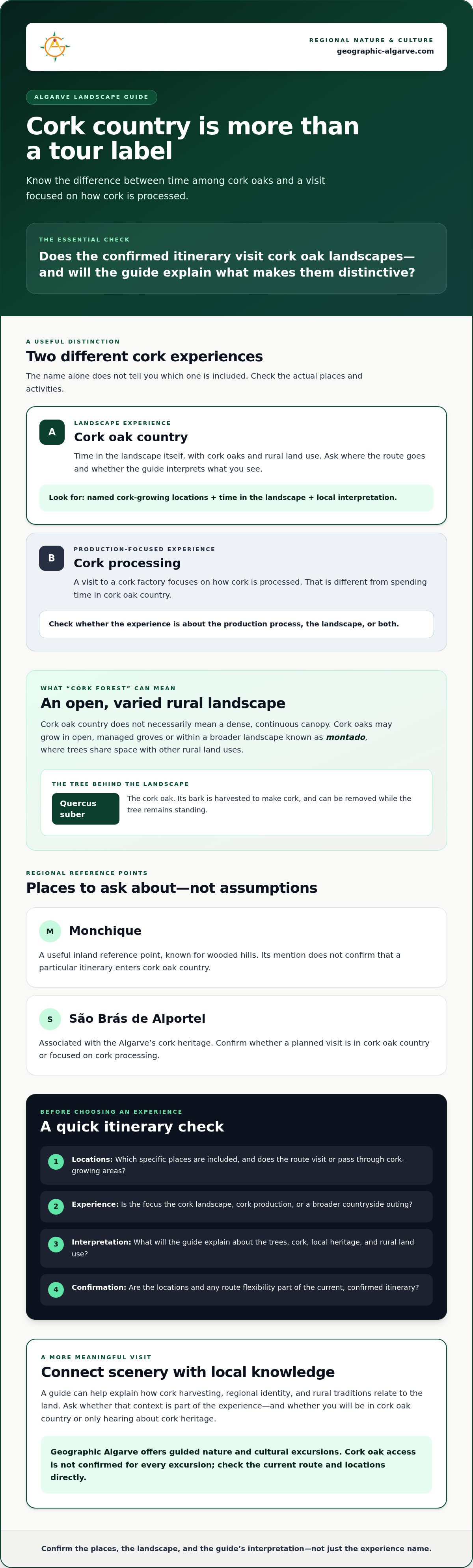
What to ask before booking a cork forest tour in the Algarve
A clear enquiry can help you avoid booking a countryside outing that does not include the landscape you hoped to see. Ask for specific answers, especially if the description uses broad terms such as “nature” or “inland Algarve.” Use this checklist before you commit.
Questions that confirm whether cork landscapes are included
Start with the location and the experience itself. A mention of cork heritage might mean the guide discusses cork production, not that the outing visits cork oak areas. Ask the operator to distinguish confirmed itinerary details from possibilities.
- Which specific locations are included? Ask whether cork oak areas are part of the planned itinerary and where the visit takes place.
- Is access to cork landscapes confirmed? Clarify whether you will spend time among cork oaks or may only see them along the way.
- What will the guide explain? Ask whether the interpretation covers cork production, local traditions or the landscape’s environmental context.
- What does broad wording mean? If the description says “countryside” or “nature,” ask what landscape you will actually visit.
Questions about matching the experience to your plans
Once the location and focus are clear, check the practical details. Do not assume that flexibility, a particular language or a specific stop is included unless the operator confirms it. Access and seasonal conditions may affect plans, so ask what applies to your intended date.
- 5. What flexibility is confirmed? Ask whether the itinerary can be adapted and what changes, if any, may affect the planned locations.
- 6. Which languages are available? Confirm the language for your specific outing rather than relying on a general description.
- 7. How long is the outing, and where do we meet? Verify the scheduled duration and meeting arrangements directly.
- 8. Are there practical requirements? Mention your interests or any needs relevant to participation, then ask what the experience involves. Do not assume unlisted inclusions.
These questions help you assess any “jeep tour through cork forests” by its actual itinerary, not its label. Geographic Algarve offers guided nature and cultural excursions, but you should confirm whether the specific experience includes a cork oak visit. Ask about locations, language options and any confirmed flexibility before deciding.
Explore Algarve landscapes with Geographic Algarve's local guides
A guided Algarve experience can reveal more than scenic views. Geographic Algarve offers nature and culture-based excursions shaped by local knowledge, with a focus on the region’s landscapes and ethnocultural geography. This perspective can connect what you see with the traditions and ways of life that have shaped the area.
A locally guided way to discover the Algarve
Founded and managed by local expert Vasco Salgueiro, Geographic Algarve brings more than 25 years of experience to its guided excursions. Its multilingual local guides can add context to the region’s natural and cultural features, helping visitors explore beyond a checklist of stops. The company also highlights a focus on sustainable tourism.
If cork oak landscapes interest you, ask how the guide explains cork’s place in the region’s heritage and what landscape the itinerary actually includes. Geographic Algarve offers guided nature and cultural experiences, but a cork forest visit is not confirmed for every itinerary. Do not assume that a broad countryside description means cork oak areas are included.
How to enquire about a cork-focused itinerary
Be specific in your enquiry. Explain that cork oak landscapes are a priority, then ask the team to confirm the locations and itinerary details for the experience you are considering. If you are searching for a jeep tour through cork forests, treat that phrase as a starting point for questions, not proof of a particular route.
You can also say what matters most to you: learning about cork production, seeing inland scenery or understanding local traditions. That gives the team a clear sense of your interests, while its reply can clarify what is and is not included. Confirm any details that will shape your plans before booking.
Explore the available guided Algarve experiences and ask whether a current itinerary can include cork oak landscapes. Confirm the route and locations directly before booking.
Choose your Algarve experience with confidence
The most rewarding cork-focused outing is one that matches its description. Confirm whether the itinerary includes cork oak landscapes, which locations are planned and how the guide will explain the region’s cork heritage. A broad countryside label is not confirmation. If you are looking for a jeep tour through cork forests, ask clear questions about the actual route and experience.
Local interpretation can bring inland scenery and regional traditions into focus. Geographic Algarve offers nature and culture-based excursions and is founded and managed by local expert Vasco Salgueiro. The team’s multilingual local guides bring regional knowledge to its experiences. Cork landscape access still needs to be confirmed for the specific itinerary.
To plan your visit, explore Geographic Algarve’s guided experiences and ask about cork landscapes. Share what you hope to see, then confirm the locations and current itinerary directly. With those details in hand, you can choose an Algarve outing that suits your interests.
Frequently Asked Questions
Where can I see cork oak forests in the Algarve?
Look inland, particularly around Monchique and São Brás de Alportel, both associated with the Algarve’s cork heritage. That does not mean every excursion in these areas visits cork oak landscapes. Ask which specific locations are included and whether you will see cork oaks directly. The coastal scenery around Lagos, Albufeira and Carvoeiro offers a different picture of the region.
Can a guided Algarve tour take me through cork forests?
It may be possible, but confirm the itinerary with the tour operator. A general description of countryside or nature does not guarantee a visit to cork oak areas, and a discussion of cork heritage may not include time among the trees. Ask which locations are confirmed and what the guide will explain. Geographic Algarve offers guided nature and cultural excursions, but check whether the current itinerary includes cork landscapes.
What is special about cork oak forests in Portugal?
Portugal’s cork oak landscapes connect a distinctive natural environment with a long-standing tradition of cork production. Cork comes from the bark of the cork oak, and harvesting knowledge has been passed down through generations. In the Algarve, open cork oak landscapes may form part of the montado, a traditional system that combines trees with other rural land uses. A knowledgeable guide can help explain the ecological and cultural context.
How do I choose a cork forest tour in the Algarve?
Choose by checking the itinerary, not just the tour name. Look for named locations or a clear description of the landscape, then ask whether cork oak areas are a confirmed part of the experience. Find out whether the guide will discuss cork production and local heritage, and clarify any flexibility or seasonal considerations. If the description only says “countryside,” ask what you will actually visit before booking.
Is Monchique a good place to look for cork oak landscapes?
Monchique is a useful inland reference point for exploring the Algarve’s wooded hills and cork heritage. The surrounding area is associated with cork landscapes, but that does not confirm that a particular excursion visits them. Ask the operator whether cork oak areas are included, which locations are planned and what access is possible for your chosen date. Treat Monchique as a place to ask about, not a guaranteed stop.
What should I ask before booking a cork forest experience?
Ask which specific locations the itinerary visits and whether cork oak areas are confirmed rather than possible sightings. Check whether the guide explains cork heritage, which language the experience is offered in and whether the itinerary can change. Confirm the scheduled duration, meeting arrangements and any practical requirements directly with the operator. If access or seasonal conditions could affect the plan, ask what applies to your date.
Can I request a private cork-focused Algarve itinerary?
You can ask Geographic Algarve whether its private tailor-made tours can include cork oak landscapes, but do not assume a particular itinerary or location is available until the team confirms it. State your interests and ask about locations and itinerary details. The company’s local focus includes Algarve, Portimão, Lagos, Albufeira, Silves, Lagoa, Carvoeiro, Alvor, Armação de Pêra, Galé, Olhos d’Água and Praia da Luz.

Article by
Kim
To conclude her studies Tourism and Recreation Management, Kim came to Portugal in 2006 for a three month internship and then simply never left! She took a few years exploring the country, living in Porto and the Algarve, while gaining experience working for the main international tour operators. Since 2013 she is a full-time local guide for Geographic Algarve, where she can share her love for and knowledge of Portugal in the best way. Both on tour and here in the blog, she shares crucial tips to get the most out of your stay in the Algarve. Kim creates her articles and photos with the help of AI, so she has more time left to show you around in the wonderful Algarve!
Disclaimer - AI generated content
This article was created by AI (including photos), within guidelines set by Geographic Algarve. Geographic Algarve checks to the best of her abilities all articles for incongruencies, but may not succeed to correct all inaccurate details before publishing. In no way or form, are these articles part of any contract when booking one of our trips. Only the specific tour information as stated on www.geographic-algarve.com is valid. In case of any doubt, please contact us via [email protected].


