

Did you know that every time you say the word "Algarve," you're actually speaking Arabic? Most travelers spend their entire vacation on the coast without ever uncovering the vibrant Islamic heart of the region. It's easy to feel like you're missing out on the real history when you're stuck in the usual tourist spots. An Algarve Moorish heritage tour solves this by taking you beyond the surface. You'll finally understand how this land transformed from a powerful Caliphate into a Christian kingdom through expert-led historical insights.
We're here to bridge that gap and bring the legacy of Al-Gharb to life. You'll gain a deep understanding of the architectural wonders and geographic shifts that defined this era. Our expert guides act as master storytellers, connecting the dots between ancient irrigation systems and the local traditions you see today. We'll explore the majestic red walls of Silves, examine well-preserved Islamic artifacts, and discover why this heritage remains the definitive highlight of the region's identity. Get ready to experience the Algarve with fresh eyes!
Key Takeaways
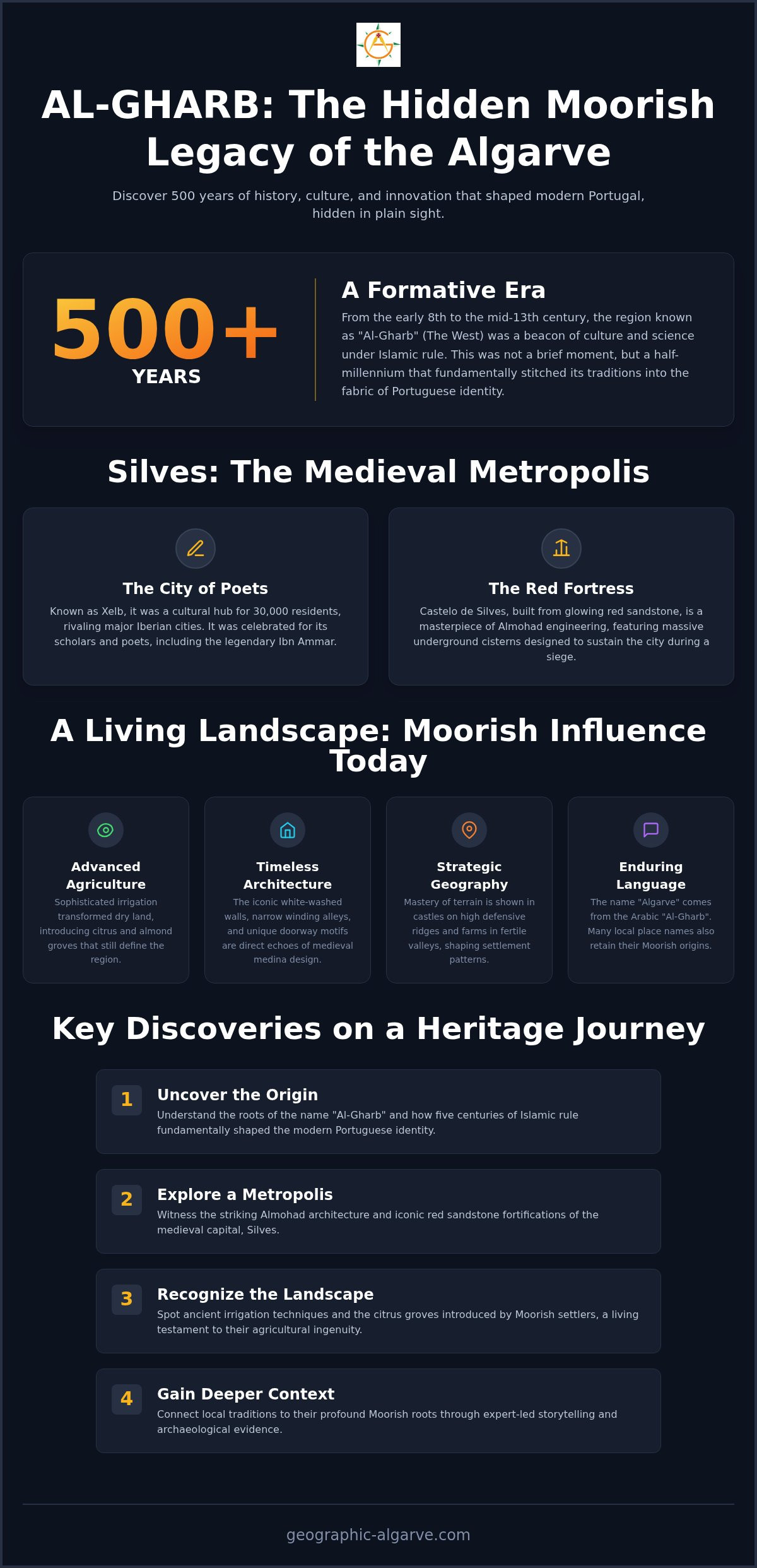
- Uncover the origins of the name "Al-Gharb" and see how five centuries of Islamic rule fundamentally shaped the modern Portuguese identity.
- Explore the medieval metropolis of Silves to witness the striking Almohad architecture and iconic red sandstone fortifications.
- Recognize the living landscape by spotting ancient irrigation techniques and the citrus groves introduced during an Algarve Moorish heritage tour.
- Master your itinerary by identifying the best seasons for exploration and the essential cultural hubs for authentic artisan crafts.
- Gain deep historical context through expert-led storytelling that connects local traditions to their profound Moorish roots.
Understanding the Islamic Legacy of Al-Gharb
Imagine standing on a sun-drenched hill, looking out over a landscape that hasn't changed its fundamental structure in a millennium. The very name "Algarve" is a living fossil. It derives from the Arabic term "Al-Gharb", which translates to "The West". During the Islamic era, this region was known as Gharb al-Andalus. For over five centuries, from the early 8th century until the mid-13th century, this territory was a beacon of culture, science, and trade. This wasn't a brief moment in history. It was a 500-year era that fundamentally stitched Islamic traditions into the fabric of Portuguese identity. From the iconic white-washed walls of traditional houses to the unique suffixes of local place names, the legacy is everywhere. An Algarve Moorish heritage tour reveals these hidden layers and brings the past into the present.
The Arrival and Expansion of Islamic Culture
The story begins with a swift movement across the Strait of Gibraltar. These settlers brought seeds, scrolls, and sophisticated administrative systems. They quickly established bustling centers like Silves and Faro. These cities became hubs where different faiths often lived side-by-side. This peaceful coexistence fostered incredible intellectual growth. Poets and scholars turned the region into a center of learning that rivaled the great cities of the East.
As the Reconquista moved south, the Algarve became a final refuge. It was the most western frontier of the Islamic world in Europe. This "end of the world" status created a unique, concentrated culture. The final years of Islamic rule saw a surge in defensive architecture and local pride. This resilience is why so many Moorish structures survived. They weren't just buildings; they were the final markers of a civilization that refused to be forgotten. When you explore these inland hills today, you're walking through the final chapter of a great medieval empire. This history isn't just in books; it's in the soil.
Why Cultural Geography Matters for Heritage Seekers
Geography dictated destiny here. The Moors were masters of the landscape. They chose high, defensive ridges for their castles and fertile valleys for their farms. You'll notice that the most historic villages sit perched on limestone massifs, perfectly positioned for defense. They also transformed the dry earth with advanced irrigation. Ethnocultural geography is the study of how human culture and landscape interact. Understanding this relationship is the key to truly seeing the Algarve. Choosing an Algarve Moorish heritage tour ensures you don't just walk past these sites; you understand why they exist exactly where they do.
Silves: The Ancient Capital of Scholars and Poets
Long ago, Silves was the cultural heartbeat of the region. Known then as Xelb, it was a medieval metropolis of 30,000 residents. This was a city that rivaled Seville and Lisbon in both prestige and intellectual power. While coastal towns focused on maritime trade, Xelb was celebrated as the "City of Poets." It was the home of legendary figures like Ibn Ammar, whose verses still echo through the annals of Iberian history. This intellectual legacy is a core focus of any authentic Algarve Moorish heritage tour. The region eventually became the last Moorish stronghold in Portugal, and Silves was its undisputed crown jewel.
The Red Sandstone Fortress (Castelo de Silves)
The visual impact of the castle is immediate and unforgettable. Its towering walls are built from "Grés de Silves," a local red sandstone that glows intensely against the green hills. This isn't just a scenic landmark; it's a masterpiece of Almohad engineering. Deep beneath the courtyard lie massive underground cisterns. The "Cistern of the Moura" is particularly impressive, designed to sustain the entire population during a months-long siege. Standing on the ramparts today, you can imagine the palatial alcáçovas and lush gardens that once stood within these walls. It’s a powerful experience that connects you directly to the defensive genius of the 12th century.
The Archaeological Museum and Islamic Architecture
To see the finer details of this era, you must visit the Municipal Archaeology Museum. The centerpiece is a stunning 12th-century Almohad well-cistern. It was discovered in situ and remains one of the best-preserved examples of Islamic water engineering in Europe. You can also trace the complex religious transition at the nearby Sé Cathedral. It sits directly atop the site of the Great Mosque, representing a fascinating layer of history. Look closely at the surrounding street layouts. The narrow, winding alleys and specific doorway motifs are direct echoes of the medieval medina. You'll find these patterns much easier to spot on our Monchique & Silves Tour, where we peel back the layers of time together!
The Living Landscape: Recognizing Moorish Influence Today
Walk through any rural valley in the Algarve interior and you'll see a landscape designed centuries ago. The Moors didn't just build castles. They built the very systems that allow life to thrive in this arid climate. An Algarve Moorish heritage tour is the best way to spot these functional markers that most travelers overlook. From the ingenious irrigation channels to the specific trees dotting the hills, the Islamic legacy is a vibrant, living reality. It's a testament to how human culture and the environment can work in perfect harmony through ethnocultural geography.
Agricultural Traditions and the Rural Interior
The Moors were masters of water management. They introduced the Nora, a clever animal-drawn water wheel that pulled life from deep within the earth. You can still find these structures tucked away in the Barrocal region, often surrounded by ancient irrigation channels that still feed the soil. They transformed dry, dusty hills into lush, productive orchards by perfecting dry-stone walling techniques. These terraces prevented erosion and allowed for the widespread introduction of almond, fig, and citrus trees.
Today, these crops are the backbone of the region's identity. Even our local gastronomy relies on these historical roots. Famous treats like Dom Rodrigo or almond-based sweets are direct culinary descendants of Islamic kitchen traditions. This isn't just a lesson in history; it's the literal flavor of the land. When you see a hillside covered in white almond blossoms in early spring, you're looking at a tradition that began over a thousand years ago.
Architecture Beyond the Castles
Look up when you visit the cubist streets of Olhão or the historic center of Tavira. You'll see the açoteia, or flat roof terrace. These were originally designed for drying fruits and grains, but they also served as private outdoor spaces for families to enjoy the evening air. The architecture is a brilliant, practical response to the intense southern sun. Thick, white-washed walls reflect the heat and keep interiors cool through thermal mass, a technique that remains effective today.
Don't forget to examine the chimneys! These elaborate, lace-like structures are a lingering artistic signature of the East. Each one is a unique work of art, often commissioned to show the owner's status. They are essentially stone lace, reflecting a tradition of craftsmanship that dates back to the Islamic period. In the winding alleys, you'll find shaded pátios and intricate geometric tile work that create a profound sense of sanctuary. These design choices turn every village walk into a fascinating discovery of ancient Mediterranean wisdom.
Planning Your Heritage Journey in the Algarve
Timing is everything when you want to truly connect with the past. We recommend planning your visit during the Spring or Autumn months. During these seasons, the light is soft and the temperatures are ideal for walking through ancient streets. An Algarve Moorish heritage tour during these times allows you to see the landscape in its most vibrant state. You'll avoid the heavy summer crowds and find a more authentic rhythm in the local villages. The air is fresh. The hills are green. It’s the perfect time for discovery!
Focus your journey on three essential hubs. Silves remains the historical heart. Loulé is the place to go for artisan crafts. Tavira offers some of the most striking examples of traditional architecture. Don't just look at the buildings. Take the time to engage with local artisans. You can still find masters practicing traditional pottery and weaving in hidden workshops. Their techniques are living links to the Islamic era. These craftsmen are often happy to share their stories. This personal connection makes the history feel much more tangible. It turns a simple walk into a meaningful cultural exchange.
Essential Sites for a Moorish Itinerary
Start in Loulé to see the incredible 12th-century Islamic baths. These were only recently uncovered and offer a rare glimpse into the daily social rituals of Al-Gharb. Next, head to the wild Southwest coast to explore the Aljezur castle ruins. The view from these ramparts over the river valley is spectacular. Finally, wander through Faro. The ancient city walls still stand strong, and the hidden "Mouraria" district reveals the layered history of the city's inhabitants after the Christian conquest. These sites are the pillars of the region's Islamic story.
How to Differentiate Authentic History from Tourist Fiction
Real history is often found in the quiet details. Look for the "Blue Flag" of heritage sites, denoting official preservation. You should also look for interpretive signage provided by local historical societies. These panels offer deep context that you won't find in a generic guidebook. To get the most out of your trip, seek out Algarve cultural tours led by specialists who live and breathe this history. An expert guide acts as a master storyteller, interpreting the "silent" history written into the very soil and stones. Ready to start your adventure? Book your private tailor-made tour today!
Expert-Led Cultural Journeys with Geographic Algarve
Choosing the right guide transforms a simple walk into a life-changing discovery. At Geographic Algarve, our philosophy centers on ethnocultural geography. We don't just show you the sights; we immerse you in the deep connection between the land and its people. Our local expert, Vasco Salgueiro, brings over 25 years of experience to every Algarve Moorish heritage tour. We take pride in being master storytellers of the landscape. Our multilingual guides live and breathe these traditions, ensuring your time is precious and well-spent! You'll gain insights that self-guided walks simply cannot provide.
Small-group excursions are the core of our approach. This ensures a personalized feel where every question is answered with academic-level expertise. We want you to feel like you're exploring with a knowledgeable friend rather than a faceless company. By focusing on quality over volume, we make sure your heritage journey is the definitive highlight of your entire trip. It's about maximizing your experience while connecting with the authentic soul of Al-Gharb. We are your gateway to premium leisure experiences!
The Monchique and Silves Experience
Our Monchique & Silves Tour is a perfect example of this deep immersion. We start at the highest peak of the Algarve, looking out over the territory once ruled from Xelb. As we descend toward the red walls of Silves, the educational commentary brings the medieval metropolis to life. You'll learn how the mountain's water systems once fed the city below. We also make sure to highlight local gastronomy during the day. You'll have the chance to sample traditional flavors that have remained unchanged for generations. It’s a full-sensory journey through time!
Private and Tailor-Made Heritage Expeditions
Do you have a specific historical interest? Our Private Tailor-made Tours offer total flexibility. Whether you're a family seeking a fun educational outing or a professional group diving into architecture, we customize the itinerary for you. For a complete regional view, many guests combine their history focus with our Southwest coast Portugal tour. This allows you to see how the Islamic legacy reached the very edge of the continent at Sagres. We encourage you to book your 2026 journey early. Our specialists are in high demand, and we want to ensure you secure your spot. Let’s make your next vacation truly unforgettable!
Step into the Living History of Al-Gharb
The legacy of the Moors isn't just found in crumbling ruins. It's alive in the white-washed villages, the intricate chimney designs, and the very names of the towns you visit. By exploring the former capital of Silves and the hidden rural valleys, you've seen how centuries of Islamic culture still define the modern Algarve. You now know that every almond grove and ancient water wheel tells a story of innovation and resilience. An Algarve Moorish heritage tour offers the chance to see these details through the eyes of a specialist.
Don't settle for a surface-level vacation. Join local expert Vasco Salgueiro to uncover the deep ethnocultural geography of the region. With over 25 years of expertise, our team provides a sustainable and educational focus that brings silent history to life. We take pride in sharing the authentic traditions of our home with you. Book your expert-led Algarve heritage journey today and ensure your time in Portugal is truly unforgettable! The ancient paths of Al-Gharb are waiting for you.
Frequently Asked Questions
What was the Islamic name for the Algarve?
The Islamic name for the region was Al-Gharb al-Andalus, which translates to "The West of Al-Andalus." During the medieval period, this territory served as the westernmost frontier of the Islamic world in Europe. The name eventually evolved into the modern Portuguese "Algarve" that we use today. This historical designation highlights the region's importance as a distinct cultural and geographic zone within the wider Caliphate, centered around powerful cities like Silves.
Is Silves Castle the only Moorish site worth visiting in the Algarve?
Silves Castle is a masterpiece of Almohad engineering, but it is certainly not the only site worth exploring. You'll find incredible Islamic heritage throughout the region, including the 12th-century Islamic baths in Loulé and the ancient city walls of Faro. Tavira is famous for its Moorish-style architecture and bridge, while Aljezur offers stunning castle ruins overlooking the river valley. Each location provides a unique perspective on how the Islamic era shaped the local traditions.
How long did the Moors stay in Portugal?
The Moorish presence in the Algarve lasted for over 500 years, beginning in the early 8th century and continuing until the mid-13th century. While the northern parts of Portugal were retaken earlier, the Algarve remained the final stronghold of Al-Andalus until 1249. This long duration allowed Islamic culture to deeply integrate into local society, influencing everything from agriculture and irrigation to the very language and culinary traditions that define the region's identity today.
What are the most visible signs of Moorish influence in Algarve architecture?
The most visible signs include the iconic white-washed walls, flat roof terraces known as açoteias, and elaborate, lace-like chimneys. You'll also notice narrow, winding street layouts in historic centers that mimic medieval medinas. These features are a central focus of an Algarve Moorish heritage tour, as they represent practical responses to the intense southern sun. Intricate geometric patterns and shaded internal courtyards also remain popular design elements that connect modern homes to their ancient roots.
Can I see Moorish history on a day trip from Portimão or Lagos?
Yes, you can easily explore deep Moorish history starting from coastal hubs like Portimão or Lagos. Silves is just a short journey inland from these locations, making it an ideal destination for an educational day trip. You can spend the morning walking the ramparts of the red sandstone castle and the afternoon exploring the Municipal Archaeology Museum. These excursions offer a perfect way to balance beach time with a meaningful discovery of the region's cultural past.
What is the best time of year for a cultural tour of the Algarve?
Spring and Autumn are the absolute best times for a cultural journey through the region's history. During these months, the weather is mild and the natural landscape is at its most beautiful, with almond blossoms in the spring and golden light in the fall. You'll find that the historic sites are much quieter, allowing for a more immersive and thoughtful experience. Avoiding the peak summer heat makes walking through the sun-drenched streets much more pleasant.
Why was Silves so important during the Moorish era?
Silves, then known as Xelb, was the capital of the region and a major intellectual center of the Islamic world. It was a bustling metropolis of roughly 30,000 residents, famous for its poets, scholars, and sophisticated philosophers. The city's location on a defensive ridge and its advanced water engineering made it a powerful administrative and military hub. It rivaled the great cities of Seville and Lisbon in prestige, serving as the cultural heartbeat of Al-Gharb.

Article by
Kim
To conclude her studies Tourism and Recreation Management, Kim came to Portugal in 2006 for a three month internship and then simply never left! She took a few years exploring the country, living in Porto and the Algarve, while gaining experience working for the main international tour operators. Since 2013 she is a full-time local guide for Geographic Algarve, where she can share her love for and knowledge of Portugal in the best way. Both on tour and here in the blog, she shares crucial tips to get the most out of your stay in the Algarve. Kim creates her articles and photos with the help of AI, so she has more time left to show you around in the wonderful Algarve!
Disclaimer - AI generated content
This article was created by AI (including photos), within guidelines set by Geographic Algarve. Geographic Algarve checks to the best of her abilities all articles for incongruencies, but may not succeed to correct all inaccurate details before publishing. In no way or form, are these articles part of any contract when booking one of our trips. Only the specific tour information as stated on www.geographic-algarve.com is valid. In case of any doubt, please contact us via [email protected].


