

What if the most breathtaking wildlife encounter in Europe is hiding in plain sight along the Portuguese coast? You might think you need to travel to the ends of the earth to see rare predators or marine life, but the vibrant wildlife of the Algarve region proves otherwise. From the tranquil lagoons of Ria Formosa to the dramatic cliffs of the Costa Vicentina, this protected bio-reserve is a sanctuary where the land meets the Atlantic. It creates a unique Mediterranean microclimate that supports a rich diversity of marine species and some of the continent's rarest birds, defining a landscape shaped by ancient geology and centuries of natural isolation.
It's frustrating to explore for hours only to miss a sighting because you didn't know where to look or which rules to follow. Identifying species without expert help is a common hurdle for many explorers. This guide from Geographic Algarve promises to transform your next visit into an educational journey through the Algarve's natural wonders. You'll discover where to find resident pods of bottlenose dolphins and how to spot the elusive Bonelli’s Eagle. We'll preview the best trails for secret viewpoints and explain vital seasonal access regulations. Get ready to appreciate the Algarve's natural heritage with the confidence of a local expert.
Key Takeaways
- Discover how the unique limestone ridge creates a Mediterranean oasis sheltering over 213 vertebrate species.
- Learn where to observe the rare Bonelli's Eagle, Portugal's only coastal nesting pair, while exploring the wildlife in Arrábida Natural Park.
- Understand the ecological link between the protected marine park and the resident colony of 30 bottlenose dolphins.
- Uncover the habits of elusive terrestrial mammals like the Egyptian Mongoose and the Genet that thrive in this bio-reserve.
- Master the timing and photography secrets needed to capture Arrábida's vibrant fauna during the peak seasons of Spring and Autumn.
The Mediterranean Oasis: Arrábida’s Unique Geography
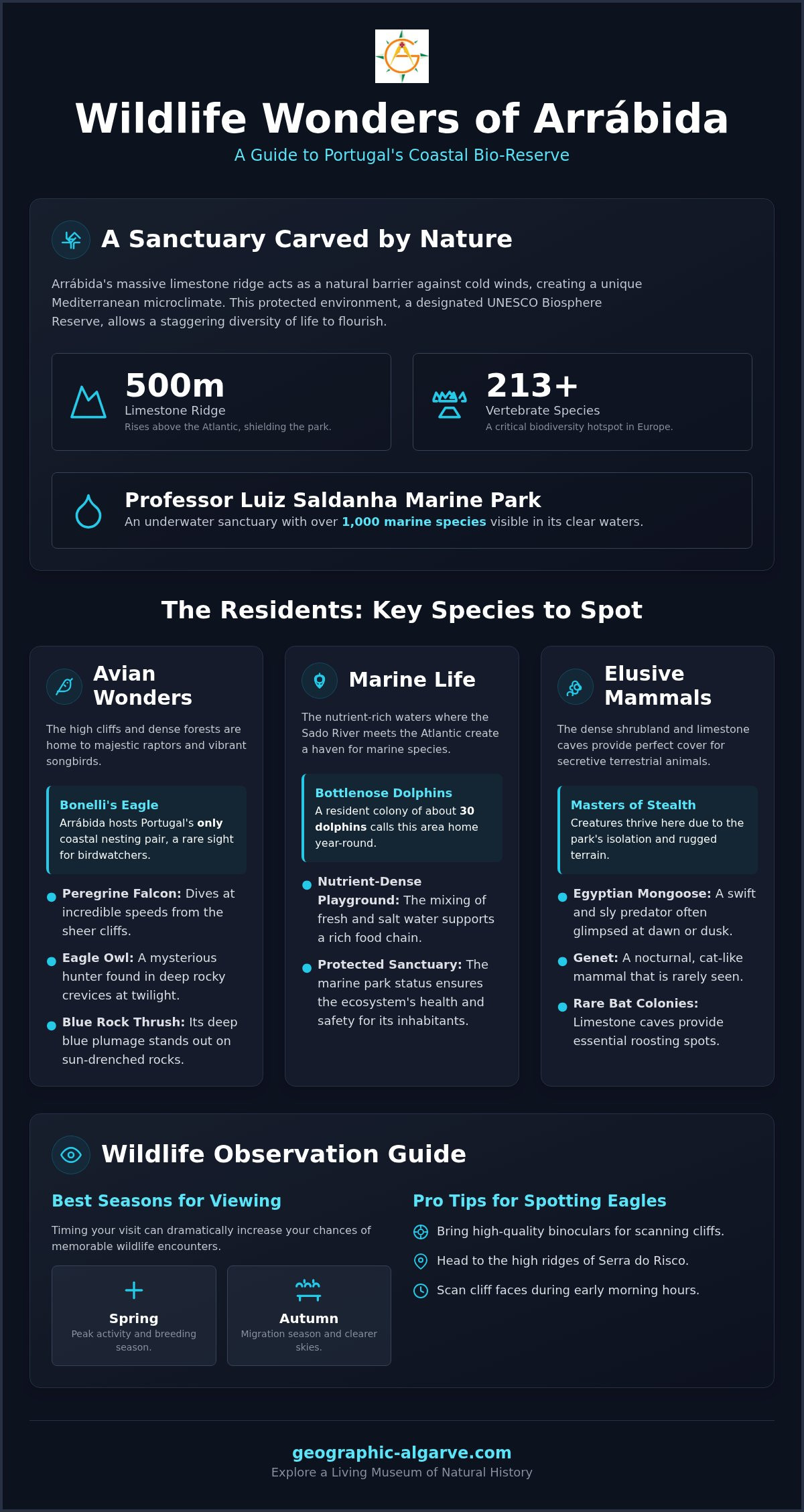
Arrábida is a geological marvel that defies expectations! Imagine a massive limestone wall rising 500 meters above the Atlantic. This ridge isn't just for show; it serves as a protective barrier against cold northern winds. It creates a Mediterranean microclimate that feels worlds away from the rest of the region. Because of this unique shield, the wildlife in Arrábida Natural Park thrives in a warm, sheltered pocket. This terrain supports a staggering 213 vertebrate species, making it a critical biodiversity hotspot for both Portugal and Europe.
The park sits at a dramatic intersection where the fresh waters of the Sado River meet the salty Atlantic Ocean. This mixing zone creates a nutrient-dense playground for marine life! It's the reason why the resident bottlenose dolphins call this area home year-round. From an ethnocultural geography perspective, the sheer ruggedness of the cliffs and the density of the maquis shrubland have acted as a natural fortress. This isolation preserved rare species that would have otherwise vanished under the pressure of human expansion. Exploring Arrábida Natural Park is an educational journey through a living museum of natural history.
The Limestone Microclimate
The mountain ridge acts as a thermal regulator. By blocking the Atlantic's harsher moods, it allows plants like the wild olive, mastic tree, and Phoenician juniper to flourish. These aren't just plants; they are the foundation of the local ecosystem! They provide vital food and nesting sites for local bird populations. This delicate balance is why the area holds its prestigious UNESCO Biosphere Reserve status. Every square meter is optimized by nature to support life. The warmth trapped here ensures that the wildlife in Arrábida Natural Park enjoys a longer active season than in more exposed coastal areas.
A Landscape Carved for Fauna
Water and time have sculpted the limestone into a labyrinth of caves and crevices. Explore these hidden chambers that provide essential roosting spots for rare bat colonies! Some of these species are found in only a few locations across Portugal. Look down from the coastal cliffs to see the Professor Luiz Saldanha Marine Park. It's a protected underwater sanctuary with over 1,000 marine species visible through the clear water. This interconnected geography is a core part of what you'll experience on a Southwest coast Portugal tour. The focus remains on these pristine ecosystems and their survival. It's a landscape specifically carved to protect its inhabitants!
Avian Wonders: Spotting the Rare Bonelli’s Eagle
The Bonelli’s Eagle is the undisputed crown jewel of the sky here! While most of these majestic raptors prefer inland mountain ranges, Arrábida hosts the only coastal nesting pair in all of Portugal. This rare occurrence makes the wildlife in Arrábida Natural Park a magnet for serious birdwatchers and nature enthusiasts alike. Spotting one of these eagles soaring against the backdrop of the turquoise Atlantic is a memory that stays with you forever. It's a testament to the park's status as a high-value sanctuary for endangered species.
The Raptors of the High Cliffs
High above the limestone slopes, these hunters utilize the rising thermals to patrol their territory with effortless grace. The Peregrine Falcon also calls these sheer cliffs home. Watch in awe as they dive at incredible speeds to catch prey mid-air! Even the mysterious Eagle Owl finds sanctuary in the deep rocky crevices, emerging only as twilight settles over the ridge. Historically, these birds served as vital markers for Portuguese sailors navigating the coast. Seeing raptors circling the high peaks meant land was near, providing a feathered lighthouse for weary explorers returning from the sea.
Pro tip: Bring a high-quality pair of binoculars and head to the high ridges of the Serra do Risco. Scan the vertical faces during the early morning hours to catch a glimpse of the eagles leaving their nests. The limestone provides a stark contrast that helps you spot movement against the rock. If you want to maximize your chances of a sighting, our Private Tailor-made Tours offer the expertise needed to track these birds without disturbing their natural habitat.
Songbirds of the Emerald Forest
The forest canopy and dense Mediterranean scrub are just as alive as the high cliffs! The Blue Rock Thrush is a frequent sight on the sun-drenched rocks. Its deep blue plumage contrasts beautifully with the grey limestone and green shrubs. In the thickets, the Nightingale provides a constant, melodic soundtrack during the spring nesting season. This dense vegetation offers the perfect cover for smaller species to raise their young safely. The Risco cliff stands as a primary habitat for cliff-nesting raptors, creating a vertical ecosystem where different species occupy specific layers of the mountain. It's a complex web of life that depends on every inch of this protected landscape.
Marine Life and the Sado Estuary Dolphins
The Sado Estuary is home to a resident colony of approximately 30 bottlenose dolphins, the largest population of its kind on the Iberian Peninsula! These magnificent creatures are sedentary, meaning they live in the estuary year-round rather than migrating. This rare behavior makes them a crown jewel of the wildlife in Arrábida Natural Park. Seeing them play in the surf is an experience that connects you directly to the pulse of the Atlantic. It's a spectacular sight that highlights the success of local conservation efforts.
The ecological link between the Sado Estuary and the protected marine park is a fascinating story of survival. The estuary serves as a nutrient-rich nursery for countless species that eventually move into the open sea. From the limestone heights, the turquoise waters of Portinho da Arrábida offer a crystal-clear viewing window into this underwater world. Look across the blue expanse to see the shimmering white dunes of the Tróia Peninsula. It's a landscape of staggering beauty where the river's fresh flow meets the ocean's salt in a perfect biological dance.
Observing from the Heights
You don't need to be on the water to enjoy these marine wonders. Head to the Miradouro do Portinho for a truly breathtaking perspective! From this secret vantage point, you can often spot dolphin pods breaking the surface of the calm bay below. The surrounding salt marshes are equally vital to the food chain. They act as natural filters and provide a haven for juvenile fish and crustaceans. This deep connection to the sea is a major theme in our Algarve cultural tours, where we explore how the coastal heritage has shaped the lives of local communities for generations.
The Luiz Saldanha Marine Reserve
Beneath the towering cliffs lies the Professor Luiz Saldanha Marine Park, a sanctuary protecting over 1,000 species of marine life! The underwater limestone reef provides a complex habitat where sea fans, octopuses, and vibrant schools of fish thrive in the clear water. It's one of the most biodiverse marine areas in Europe. Protecting this fragile border requires strict sustainable practices and deep local knowledge. Every visitor plays a role in preserving this bio-reserve for the future. By choosing an educational journey focused on ethnocultural geography, you gain a deeper appreciation for the wildlife in Arrábida Natural Park and the delicate balance of its marine ecosystems.
Terrestrial Secrets: Mammals of the Limestone Ridge
While the dolphins and eagles often steal the spotlight, the hidden wildlife in Arrábida Natural Park includes a fascinating array of land-dwelling mammals. The dense Mediterranean scrub provides the perfect hideout for the elusive Egyptian Mongoose and the spotted Genet. These predators are masters of stealth! You might spot a Red Fox darting through the underbrush or find evidence of a Badger's nocturnal digging near the limestone ridges. These animals aren't just residents; they are the architects of the local ecosystem. They maintain the balance between prey populations and the health of the flora.
The historical isolation of the 'Convento' area played a massive role in their survival. This sacred ground, home to the Franciscan monks since the 16th century, acted as an unofficial nature reserve long before modern laws existed. By limiting human interference and hunting, the monks inadvertently created a safe zone for these terrestrial secrets to flourish. It's a perfect example of how human history and natural preservation can walk hand in hand. Exploring these ridges feels like stepping back into a time when nature ruled the landscape completely.
The Bats of the Arrábida Caves
The sea-facing limestone caves are more than just geological wonders. They are vital nurseries! The Mediterranean Horseshoe Bat is a key resident here, relying on the stable temperatures of these deep chambers for winter hibernation. These sensitive habitats are strictly protected. Conservation efforts ensure that these colonies remain undisturbed by modern exploration. Understanding the needs of these tiny mammals is essential for anyone interested in the broader wildlife in Arrábida Natural Park. It's a fragile world that depends on the silence of the cliffs.
Ethnocultural Preservation of the Fauna
Arrábida's history is deeply intertwined with its animals. For centuries, the Franciscan monks' presence meant that large-scale hunting was strictly forbidden around the convent. This created a unique biological island where species could thrive without fear. Local shepherd traditions also shaped the landscape. Their management of the pastures supported healthy populations of wild rabbits, which remain a primary food source for the park's raptors. This connection between human heritage and nature is a recurring theme in our Sintra guided tour, where high-altitude heritage meets mystical landscapes.
Ready to discover these hidden wonders yourself? Book one of our Private Tailor-made Tours to explore the secret corners of the limestone ridge with an expert guide who knows every trail and burrow!
Observation Strategy: Photography and Local Guidance
Timing is everything when tracking wildlife in Arrábida Natural Park! To capture the perfect shot, you must align your lens with the 'Golden Hour.' This period, just after sunrise or before sunset, bathes the white limestone cliffs in a warm, honey-colored glow. It provides the perfect contrast for the dark silhouettes of eagles or the shimmering backs of dolphins in the bay. This light doesn't just illuminate; it reveals the textures of the landscape that remain hidden under the harsh midday sun.
Spring and Autumn are the premier seasons for observation. During Spring, the park is a riot of color as Mediterranean flowers bloom, and bird activity peaks with nesting season. Autumn brings cooler temperatures and soft light that offer a completely different set of subjects. The visibility is often superior during these months because the heat haze of mid-summer is absent. It's the best time to maximize your vacation experience and witness the full spectrum of biodiversity!
To succeed, you need the right gear and a stealthy approach. Long lenses, ideally 300mm or greater, allow you to capture detail without encroaching on sensitive habitats. Silent movement is your greatest tool! Every snapped twig or loud conversation can send an elusive Egyptian Mongoose back into its burrow. Patience is a requirement, not a suggestion. Our Private Tailor-made Tours help you master these techniques while exploring the most secluded spots with professional ease.
Capturing the Perfect Wildlife Shot
Focus on the dramatic contrasts of the landscape. The stark white of the limestone against the deep plumage of a Bonelli’s Eagle creates a powerful visual story. Use the natural framing provided by the dense kermes oak and wild olive trees to add depth to your compositions. This technique draws the eye toward the subject while showcasing the unique flora that supports these animals. For a truly iconic image, head to the cliffs near Cabo Espichel just before twilight. This is the ultimate sunset spot to capture wildlife silhouettes against a burning orange horizon!
The Value of an Expert Perspective
Looking through a viewfinder is only half the battle. To truly understand the wildlife in Arrábida Natural Park, you need to interpret the 'hidden geography.' Guides like Vasco Salgueiro, with over 25 years of local expertise, turn a simple outing into an educational journey. They know the precise ledge where an eagle might perch or the exact time a fox might cross a trail. They understand the patterns of the land that aren't visible to the untrained eye.
By looking beyond the immediate view, you discover the biological stories beneath the surface. An expert guide explains the ethnocultural links we've discussed, showing how centuries of human history have shaped animal behavior. This professional insight ensures your time is well-spent. It turns a walk in nature into a profound discovery of Portugal's natural heritage. Don't settle for a surface-level glance when you can experience the deep heritage of this bio-reserve with a passionate local partner!
Master the Art of Nature Discovery in Arrábida
Arrábida is a living sanctuary where the limestone mountains preserve a deep biological heritage. You've learned how the unique microclimate protects the rare Bonelli's Eagle and how the sedentary dolphin colony thrives in the Sado Estuary. This landscape is a masterpiece of ethnocultural geography. It's a place where history and nature are inseparable. Seeing the incredible wildlife in Arrábida Natural Park requires more than just a map; it demands an eye for detail and a respect for the bio-reserve's rules.
Ready to see these wonders for yourself? Discover the hidden nature of Portugal with an expert-led journey today! Led by local expert Vasco Salgueiro, our team brings 25+ years of local expertise in ethnocultural geography to every excursion. We specialize in sustainable and educational nature excursions that reveal the secret stories behind the landscape. Don't leave your experience to chance. Join us to find the hidden spots that only a true local knows. Your adventure into Portugal's wild heart begins now!
Frequently Asked Questions
What is the rarest animal to see in Arrábida Natural Park?
The Bonelli’s Eagle is undoubtedly the rarest animal you'll encounter. Arrábida is home to the only coastal nesting pair in Portugal, making it a high-value sighting for any enthusiast. These majestic raptors are protected under strict conservation laws within the UNESCO Biosphere Reserve. Spotting them requires patience and a keen eye for the limestone ledges where they roost. Their presence is a definitive highlight of the wildlife in Arrábida Natural Park.
Where is the best place to see dolphins in Arrábida?
The Sado Estuary and the heights above Portinho da Arrábida are the premier locations for dolphin spotting. The resident colony of approximately 30 bottlenose dolphins often plays in the turquoise waters near the Tróia Peninsula. You can observe their natural behavior from the high coastal cliffs, which provide a spectacular panoramic window into their marine world. This unique sedentary population is a testament to the nutrient-rich waters of the Professor Luiz Saldanha Marine Park.
Can I go birdwatching in Arrábida without a guide?
You can certainly explore on your own, but finding rare species like the Egyptian Mongoose or specific raptors is challenging without local expertise. Expert guides interpret the hidden geography and know the precise timing for sightings that most visitors miss. An educational journey led by a professional ensures your time is well-spent. You'll gain a deeper appreciation for the ethnocultural history that has preserved these habitats for centuries while following all protected bio-reserve regulations.
Are there wild boars in the Arrábida mountains?
Yes, wild boars are present throughout the dense Mediterranean scrub of the Arrábida mountains. These mammals are primarily nocturnal and very elusive, so daylight sightings are rare for casual hikers. They play a vital role in the ecosystem by turning over the soil, which helps certain plant species germinate. While you might see their tracks on the trails, they generally avoid human contact, preferring the deep isolation of the limestone ridges.
What is the best time of year for wildlife photography in Arrábida?
Spring and Autumn offer the most exceptional conditions for capturing wildlife in Arrábida Natural Park. During these months, the light is softer and the heat haze of summer is absent, providing crystal-clear visibility for long-range photography. Spring brings vibrant bird activity and blooming flora, while Autumn offers a tranquil atmosphere for tracking terrestrial mammals. Always aim for the 'Golden Hour' at sunrise or sunset to capture the dramatic contrast of the limestone landscape.
Are the wildlife viewing spots accessible for families?
Many of the park's most famous viewpoints are perfectly accessible for families and offer incredible educational opportunities. Locations like the Miradouro do Portinho provide safe, stunning vistas where children can learn about marine biology and coastal history. While some interior trails are more rugged, the coastal overlooks allow families to experience the park's majesty without strenuous effort. It's a fantastic way to inspire a love for nature and sustainable tourism in the next generation.
What should I bring for a day of nature observation in Arrábida?
Preparation is key for a successful day of observation! You should pack high-quality binoculars and a camera with a long focal length lens to see animals without disturbing them. Bring plenty of water, high-SPF sun protection, and wear neutral-colored clothing to blend into the environment. Sturdy footwear is essential for the limestone terrain. Remember that silence is your best tool, as quiet movement significantly increases your chances of spotting the park's more elusive residents.
Is it possible to see the Sado dolphins from the shore?
It is absolutely possible to see the dolphins from the shore if you know where to look! The high cliffs of the Serra da Arrábida act as a natural stadium overlooking the Sado Estuary. On calm days, the dark shapes of the pods are clearly visible against the turquoise water from spots like the Miradouro do Norte. This perspective allows you to witness their social interactions across the bay without needing to be on the water.

Article by
Kim
To conclude her studies Tourism and Recreation Management, Kim came to Portugal in 2006 for a three month internship and then simply never left! She took a few years exploring the country, living in Porto and the Algarve, while gaining experience working for the main international tour operators. Since 2013 she is a full-time local guide for Geographic Algarve, where she can share her love for and knowledge of Portugal in the best way. Both on tour and here in the blog, she shares crucial tips to get the most out of your stay in the Algarve. Kim creates her articles and photos with the help of AI, so she has more time left to show you around in the wonderful Algarve!
Disclaimer - AI generated content
This article was created by AI (including photos), within guidelines set by Geographic Algarve. Geographic Algarve checks to the best of her abilities all articles for incongruencies, but may not succeed to correct all inaccurate details before publishing. In no way or form, are these articles part of any contract when booking one of our trips. Only the specific tour information as stated on www.geographic-algarve.com is valid. In case of any doubt, please contact us via [email protected].


