
The Algarve’s Moorish past isn’t a single, uninterrupted story of rulers and dates. Understanding Algarve's Moorish history means looking at changing powers, local communities and the places where their lives unfolded. If the chronology feels hard to follow, you’re not alone: the word “Moorish” can blur distinct peoples and periods into one.
This guide explains how Muslim rule took shape from the eighth century, how the region changed before the Christian conquest concluded in 1249, and why that shift wasn’t a clean break from everything that came before. The aim is context, not a list of dates to memorise.
Then, bring the story into view. From Silves, once known as Xelb, to castles and historic town centres, discover what visitors can explore today and how landscape, settlement and cultural exchange shaped the Algarve’s legacy. Read with informed curiosity, and let the region’s surviving traces add depth to your visit.
Key Takeaways
- Build a clearer timeline by treating Moorish rule as a broad historical label, not one unchanging period or community.
- See how understanding Algarve's Moorish history involves connecting political change with settlement and everyday life.
- Learn to read castles, place names and cultural interpretations as different kinds of clues, each with its own limits.
- Use a simple approach in Silves: establish the period, observe the place, then consider what the evidence can support.
- Discover how local cultural guides can add regional context while connecting heritage with the Algarve’s landscapes.
Understanding the Algarve’s Moorish History: How the Region Entered Al-Andalus
In Algarve history, “Moorish rule” broadly describes periods when Muslim-led states governed the region, from the early medieval centuries until the Christian conquest in the thirteenth century. It isn’t the name of one uniform people or a single, unchanging government. For understanding Algarve's Moorish history, begin by separating political rule from the identities and beliefs of the people who lived under it.
What does “Moorish” mean in Algarve history?
“Moorish” is a broad label used in European histories for Muslim peoples and societies associated with North Africa and the Iberian Peninsula. It can be useful shorthand, but it can also hide differences. Arab and Berber communities had distinct backgrounds, while people in Iberia could identify through religion, language, place, family or political allegiance. These categories overlapped, but they weren’t interchangeable.
Muslim describes a religious identity; Arabic can refer to a language and, in some contexts, cultural or ancestral connections; Berber refers to diverse peoples of North Africa. Nor did Muslim rule mean every resident was Muslim or spoke Arabic. The population and its affiliations changed over time. Avoid imagining one society with one shared identity, or assuming that a ruler’s religion tells us what every person in the Algarve believed.
When did Muslim rule reach the Algarve?
The familiar starting point is 711, when Muslim-led forces crossed from North Africa into the Iberian Peninsula and the Visigothic kingdom began to fall. This marks the beginning of a major political transformation across Iberia, not proof that every town in the far south-west changed hands in that same year. Control expanded through campaigns and changing alliances, and the Algarve became part of the wider territory known as Al-Andalus.
Al-Andalus was not a single state with fixed borders throughout its history. Authority shifted between dynasties and political centres, and regional power changed with it. The Algarve’s position in the south-west gave it a distinct place within these wider developments. Silves later became a major stronghold, but that prominence belongs to the region’s evolving story, not a claim that it was the centre of events from the first arrival. The overview of Algarve's Moorish history also identifies Silves’ importance and the region’s later Christian conquest.
Christian expansion in Iberia unfolded over centuries. The Algarve’s incorporation into the Portuguese kingdom was completed in 1249, a regional milestone within that longer process. It ended Muslim political rule in the region, but it doesn’t mean every community vanished or that cultural change stopped on that date.
The Algarve’s political story moved through changing authorities, while its population, faiths and cultural identities remained varied and cannot be reduced to a single label. Keep that distinction in mind as you follow the chronology. It makes the history more accurate and helps you interpret what Silves and other places can reveal.
How Moorish-Period Power and Daily Life Took Shape in the Algarve
Political change didn’t reach every community in the same way. Authority shifted across Al-Andalus over the centuries, while local settlements developed within their own landscapes and connections. To understand Algarve's Moorish history, look beyond a succession of rulers: the record is also shaped by where people lived, what evidence remains and how cautiously we interpret it.
Why was Silves significant?
Silves, known as Xelb during the Muslim period, became one of the Algarve’s major urban centres and a significant stronghold. Its regional importance is associated with its role as a centre of authority and settlement, not simply with the presence of a castle. The city’s standing changed across different political periods, so descriptions such as “capital” should be understood in their historical context rather than as a permanent status.
Silves mattered because it connected regional authority to a wider network of Algarve settlements, not because it represented every community in the region. Coastal settlements, rural communities and other inland places had their own circumstances. A city’s prominence can help explain how power was organised, but it can’t tell us that daily life was the same throughout the Algarve.
What can historical evidence tell us about everyday life?
Archaeology offers tangible clues, but each find answers only certain questions. In Silves, the Almohad-period well-cistern, now presented at the Municipal Museum of Archaeology, provides evidence of water management and the built environment. It doesn’t, on its own, reveal how every household obtained water or prove that the same systems served settlements across the region.
Other traces of settlement can help researchers consider how buildings and public spaces changed over time. But a surviving structure may have been altered, reused or restored, and its visible form may not belong entirely to the Moorish period. Distinguish the physical remains from later explanations about what they mean.
Daily life also involved work, exchange and relationships with the surrounding land. The balance would have varied by location: communities near urban centres faced different conditions from those in rural areas or along the coast. The British Historical Society of Portugal’s account of Daily life in Islamic Portugal offers wider context for considering Muslim communities and their relationship with the land. Use that context as a guide, not as proof that every practice described applied equally in the Algarve.
For visitors, Silves is a strong place to begin asking these questions. Observe what is clearly preserved, then separate that evidence from broader interpretations of regional life. A locally guided experience from Geographic Algarve can add geographical and cultural context to what you see, connecting the site with Portuguese culture and the region’s varied landscapes.
What the Algarve’s Moorish Legacy Can, and Cannot, Tell Us Today
A historic wall, an old place name and a modern tradition don’t tell the same kind of story. Each is a clue, but each needs its own context. For understanding Algarve's Moorish history, distinguish what evidence directly shows from what later interpretation suggests.
Which traces are useful clues to the Moorish past?
Silves offers a useful example. The Almohad-period well-cistern at the Municipal Museum of Archaeology is a specific archaeological feature associated with a named historical period. It can help visitors consider water management and urban life. It can’t, by itself, show how every resident used water or establish that similar systems existed throughout the Algarve.
Place names offer a different kind of evidence. “Algarve” derives from the Arabic al-Gharb, meaning “the west”. This linguistic trace points to the region’s historical connections, but a name alone doesn’t describe the people who used it or prove that a present-day custom has remained unchanged since the medieval period.
Use this simple distinction as you explore:
| Clue | What it can suggest | What it cannot prove alone |
|---|---|---|
| Almohad-period well-cistern in Silves | Evidence of a water-related structure from a particular historical period. | How all households obtained water or how other settlements were organised. |
| The name “Algarve” | A linguistic connection to Arabic and the region’s past. | The identity, language or beliefs of every person who lived here. |
| Visible historic buildings | Layers of construction and use that can be investigated. | That every visible feature dates to Muslim rule. |
Age and distinctive appearance aren’t enough to label a building or feature Moorish. Structures may have been changed, reused or restored under later authorities. Look for a specific date, archaeological context or documented interpretation before drawing conclusions.
How did the Reconquista change the historical landscape?
The Algarve’s incorporation into the Portuguese kingdom in 1249 marked the end of Muslim political rule in the region, not an instant erasure of its population or cultural traces. A change in government could bring new administration and uses for existing places. Some structures might be adapted; others replaced or left behind. The evidence varies from site to site.
Later records can also illuminate what followed. Academic research into the legal status of Muslims in medieval Algarve offers a way to consider how Muslim communities were situated within the kingdom after conquest. Legal records reveal particular aspects of society, not the full experience of every person. Read them alongside archaeological evidence, and keep the limits of each in view.
The most careful interpretation avoids treating today’s buildings, names or customs as untouched survivals from one period. Instead, see the Algarve’s heritage as a layered landscape: evidence of change, continuity and later retelling, with each claim weighed against what the sources can support.
How to Explore Moorish History Around Silves with Context
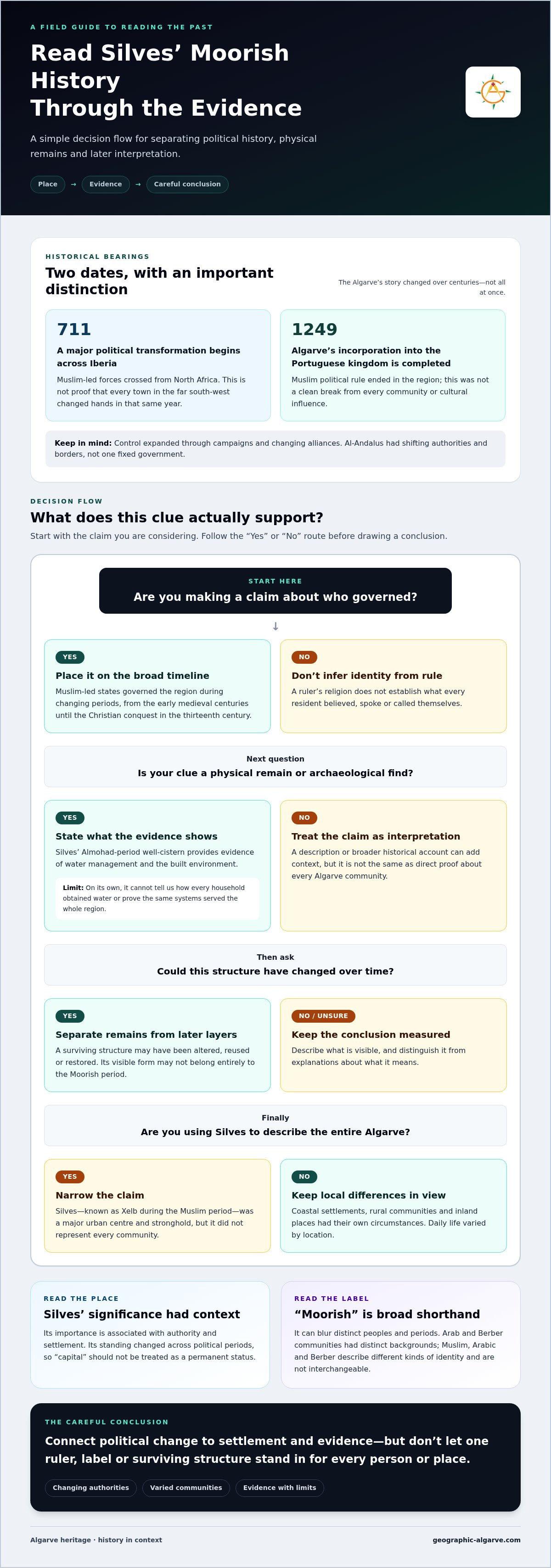
Silves is a rewarding place to explore the Algarve’s medieval past, but a visit becomes more meaningful when you look beyond a single building or period. Try this three-step method: set a historical frame, observe the place, then weigh what the evidence supports. It helps turn a walk through a historic setting into a thoughtful encounter with regional history.
What should visitors look for in Silves?
Notice how the historic centre relates to its surroundings. Look at the position of buildings, streets and open spaces, and consider how the settlement fits into the wider landscape. These observations are starting points, not proof that a particular feature dates to Muslim rule. A visible structure may include changes from later periods, so separate what you can see from the history that needs explanation.
- Establish the period. Before your visit, review a concise chronology of Al-Andalus and the Algarve. Keep broad regional events distinct from claims about a specific building or local episode. This context helps you ask better questions without assuming that every part of Silves changed at the same moment.
- Observe the place. Take time to notice how the settlement and landscape connect. At the castle or in the historic centre, focus on features that are actually visible, rather than filling gaps with assumptions. Review current museum or heritage information for site access and the interpretation of specific remains before planning around them.
- Assess the evidence. Compare what you see with information from museums, archaeological interpretation and heritage sources. Ask whether a claim refers to a dated archaeological find, a later written account or a modern reading of the past. Those sources offer different kinds of evidence, and one doesn’t automatically confirm the others.
How can a visitor read a heritage site thoughtfully?
Look for dates and explanations attached to individual features. If a structure has been restored or altered, its present appearance may reflect several periods. Let that complexity sharpen your curiosity: which parts are supported by physical evidence, and which depend on historical interpretation? You don’t need to resolve every question on the spot. Careful observation is a valuable start.
Respect the place as both heritage and part of a living region. Follow local guidance, stay on public paths, and avoid disturbing historic structures or the surrounding environment. For a deeper sense of how cultural stories connect with geography and local traditions, explore Algarve cultural heritage and guided experiences.
Understanding Algarve's Moorish history means reading Silves as one regional anchor, not a complete picture of every community. Local guides can connect visible places with Portuguese culture and geography while keeping the evidence in view. Explore Algarve heritage with local guides for added context on the region’s cultural and natural landscapes.
Continue Discovering Algarve Heritage with Local Context
The Algarve’s past comes into focus when chronology, place and evidence are considered together. A date can explain who held political power, but it can’t describe every community. A historic structure offers a material clue, yet its visible form may reflect several periods of use and change. Understanding Algarve's Moorish history means holding these perspectives together, rather than treating one building or story as the whole regional picture.
What can local cultural interpretation add?
Local knowledge can connect historical questions to the geography around them. It helps visitors consider how settlements relate to landscapes and how traditions have developed within particular places. That context doesn’t replace archaeological evidence or careful historical research. It can make the questions you bring to a site more precise and help separate what is known from what remains open to interpretation.
Geographic Algarve’s approach is educational and grounded in Portuguese culture and geography. Its local guides connect cultural and natural context, with respect for the Algarve’s environments. That perspective is useful when heritage extends beyond a single landmark. Landscapes, local traditions and historic places can inform one another, while still requiring care not to present present-day practices as unchanged relics of the medieval past.
Keep the history at the centre of your visit. Use guided interpretation to deepen your understanding, not to flatten the region’s varied communities into a single story. Ask how a place has changed, what kind of evidence supports a claim, and how its wider setting shaped local life. These questions make exploration richer and encourage respect for the people and places that carry the region’s heritage today.
Where can readers continue exploring Algarve culture?
Geographic Algarve’s cultural experiences offer a way to keep exploring the region’s traditions and landscapes. The Lost Heritage experience focuses on old traditions in the Monchique mountains. It can broaden your perspective on Algarve heritage beyond the medieval sites and questions discussed here.
For visitors drawn to the relationship between history and place, locally guided experiences add regional context while keeping environmental respect in view. Continue your exploration with discover Geographic Algarve’s local experiences. For enquiries, contact Geographic Algarve by phone at +351 969 282 549 or by email at [email protected]. The Portimão office is at Rua J.P. Sampaio Bruno 24-2º Esq., 8500-696 Portimão, Portugal.
Let the Algarve’s Stories Lead You Further
Understanding Algarve's Moorish history can be a starting point, not a final answer. Let it guide the way you encounter the region: stay curious about how people, landscapes and traditions shape one another, and leave room for discoveries beyond a single period or place.
For your next step, choose an experience that brings local traditions into conversation with the natural setting. Geographic Algarve’s cultural approach draws on ethnocultural geography and educational interpretation, adding another perspective to your time in the region.
Explore Geographic Algarve’s local cultural experiences and keep discovering the Algarve with an open mind. There’s always more to notice, and every thoughtful visit can deepen your connection to this remarkable region.
Frequently Asked Questions
When did Moorish rule begin in the Algarve?
Muslim rule began in Iberia in 711, but that date marks the start of a wider political transformation, not a confirmed change in every Algarve settlement at once. Regional control and administration developed over time, and Portuguese rule in the Algarve was established by 1249. Use these as broad chronological markers, then look for museum or heritage interpretation that connects a specific site to a particular period.
Does “Moorish” mean the same thing as “Arab”?
No. “Moorish” is a broad historical label, while “Arab” refers to particular peoples and identities. Muslim communities in Iberia included people of varied backgrounds, and identity could also be shaped by language, place and political allegiance. For example, a reference to a Muslim-ruled settlement doesn’t establish that all residents were Arab, spoke Arabic or shared the same experience.
Why is Silves associated with the Algarve’s Moorish history?
Silves is associated with the period because it was an important settlement and stronghold in the medieval Algarve. To understand Algarve's Moorish history through the city, compare what a museum identifies as period-specific evidence with broader descriptions of its regional importance. This helps avoid treating every historic feature in Silves as Moorish or assuming that one city tells the story of every Algarve community.
What does the name Algarve mean?
“Algarve” is commonly linked to the Arabic expression “al-Gharb,” usually translated as “the west.” The name offers a linguistic trace of the region’s past, but it isn’t a complete account of how the name developed or how people identified themselves. If you encounter a different spelling or translation in an exhibition or publication, compare the explanation with a reliable historical or linguistic reference.
Did Moorish influence disappear after the Reconquista?
No single political turning point can explain every later change. After the Algarve came under Portuguese rule, places and structures could be repurposed, altered or replaced, while communities experienced the transition in different ways. A claim that a present-day custom or building directly survives from Muslim rule needs specific supporting evidence. Look for a documented link, not just a resemblance or a story repeated in a general account.
Can visitors still explore Moorish heritage in the Algarve?
Yes. Silves is a useful starting point, and museum interpretation can help connect visible remains with the evidence behind them. Across the Algarve, Portimão, Lagos, Albufeira, Lagoa, Carvoeiro, Alvor, Armação de Pêra, Galé, Olhos d’Água and Praia da Luz offer varied regional settings, but their mention alone doesn’t establish Moorish-period remains. Review each site’s interpretation before drawing conclusions.
How is the Algarve’s Moorish past different from the rest of Portugal’s?
The Algarve’s story belongs to the wider history of Muslim rule in Iberia, but its south-western geography and local settlements give that story a distinct regional setting. Silves is one important reference point, not a stand-in for every part of Portugal or even every Algarve community. Compare local accounts with broader Iberian histories to see how regional events fit into larger political changes without assuming they unfolded uniformly.
Article by
Kim
To conclude her studies Tourism and Recreation Management, Kim came to Portugal in 2006 for a three month internship and then simply never left! She took a few years exploring the country, living in Porto and the Algarve, while gaining experience working for the main international tour operators. Since 2013 she is a full-time local guide for Geographic Algarve, where she can share her love for and knowledge of Portugal in the best way. Both on tour and here in the blog, she shares crucial tips to get the most out of your stay in the Algarve. Kim creates her articles and photos with the help of AI, so she has more time left to show you around in the wonderful Algarve!
Disclaimer - AI generated content
This article was created by AI (including photos), within guidelines set by Geographic Algarve. Geographic Algarve checks to the best of her abilities all articles for incongruencies, but may not succeed to correct all inaccurate details before publishing. In no way or form, are these articles part of any contract when booking one of our trips. Only the specific tour information as stated on www.geographic-algarve.com is valid. In case of any doubt, please contact us via [email protected].


