

What if your next journey could actually restore the ancient soul of the landscape instead of just passing through it? You want an escape that feels real, yet finding authentic sustainable tourism experiences Portugal offers often feels like a maze of "greenwashed" promises. It's frustrating to seek out hidden locations only to find yourself caught in the same overtourism traps as everyone else. You deserve a connection to the land that is both meaningful and impactful!
We understand that your time is precious and you want your travel spend to stay within local communities. This 2026 guide promises to lead you toward low-impact, heritage-focused discovery that respects the delicate balance of our Natural Parks. We'll explore the deep roots of ethnocultural geography, from the cork oak forests of Monchique to the protected Atlantic coastlines. Get ready to meet expert guides with 25 years of local knowledge who transform a simple walk into a masterclass in Portuguese tradition. Let's dive into the ethical way to explore the Algarve and beyond!
Key Takeaways
- Master the principles of Slow Tourism to ensure your journey balances environmental protection with meaningful cultural preservation.
- Uncover the vital link between ancient heritage and modern ecology by supporting local artisans who protect the landscape through traditional crafts.
- Learn to vet operators for genuine sustainable tourism experiences Portugal by looking for a commitment to educational travel and decades of regional expertise.
- Navigate beyond the typical beach hubs to discover the wild flora of Monchique and the protected frontiers of the Southwest Coast.
- See how 25 years of local wisdom from Geographic Algarve can turn your holiday into a premium, low-impact adventure that benefits the local economy.
Defining Sustainable Tourism Experiences in Portugal for 2026
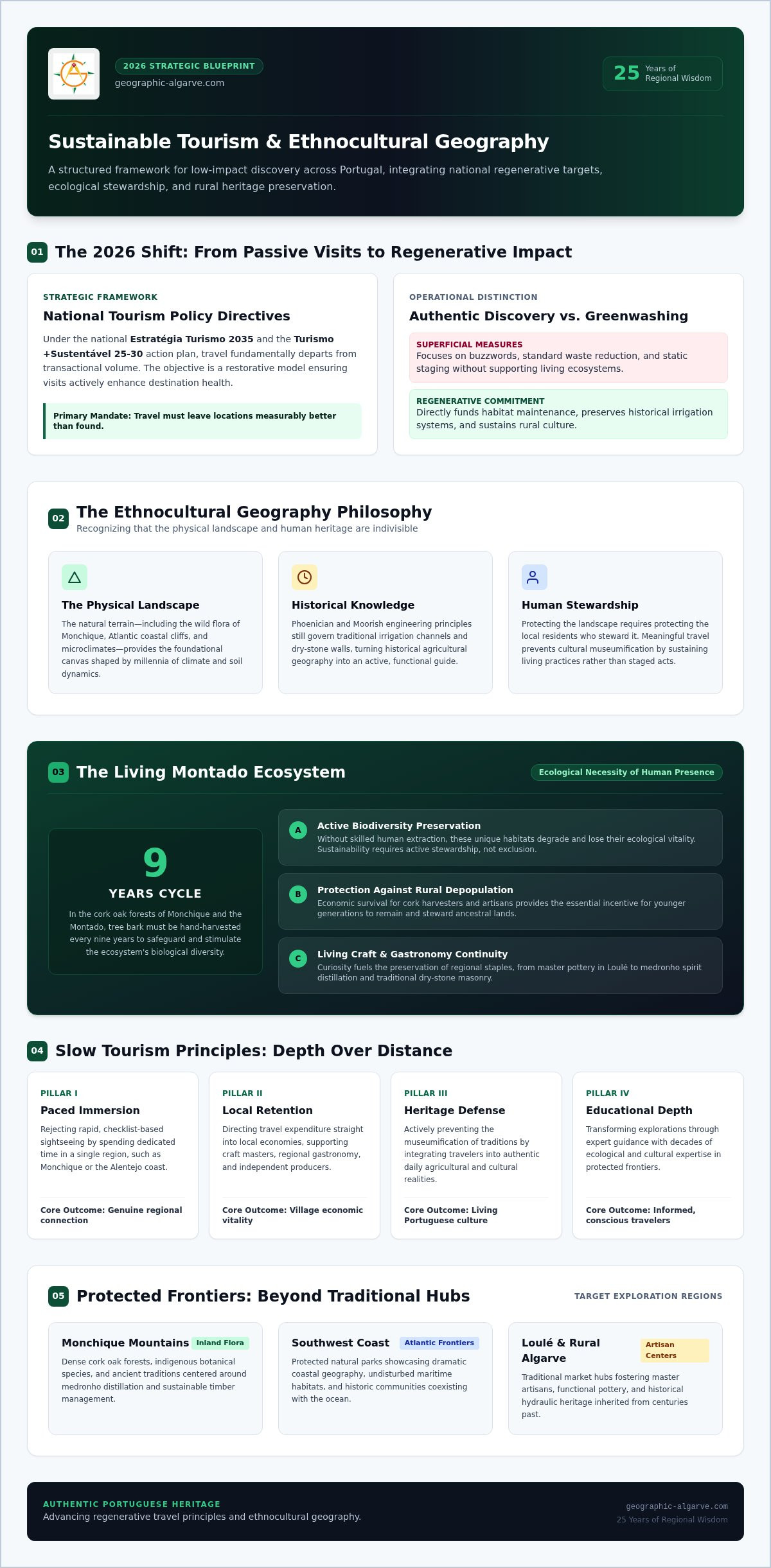
True sustainable tourism experiences Portugal offers in 2026 go far beyond simple recycling or reducing plastic waste. It's a delicate, vital balance of environmental protection, economic equity, and the active preservation of our cultural heritage. Under the national Estratégia Turismo 2035 and the Turismo +Sustentável 25-30 action plan, travel has shifted toward a regenerative model. This means your visit should leave a location better than you found it. We focus on "Ethnocultural Geography," a philosophy where we recognize that the physical landscape and human history are indivisible. You aren't just looking at a mountain; you're learning how the soil, climate, and centuries of tradition shaped the people living there.
Distinguishing between genuine impact and "greenwashing" is essential for the conscious traveler. Genuine operators don't just use buzzwords. They demonstrate a long-term commitment to the land through educational depth and community support. In the Algarve and Lisbon regions, this looks like guided explorations that fund habitat maintenance or support traditional irrigation systems. It's about choosing quality over quantity and depth over distance!
The Shift Toward Slow Tourism
In 2026, travelers are increasingly rejecting the frantic pace of traditional sightseeing. You're looking for a deeper connection to the places you visit. This movement toward "Slow Tourism" is revitalizing rural Portuguese villages that were once facing depopulation. By spending more time in a single region, like the Monchique mountains or the Alentejo coast, you allow the local economy to thrive. Your interest in a village's history or its unique gastronomy provides the financial incentive for younger generations to stay and preserve their ancestors' way of life. In Portugal, slow tourism represents a conscious commitment to linger in a landscape, prioritizing deep engagement with local heritage and ensuring travel revenue directly strengthens the economic fabric of rural villages. For those who want to experience this slow-paced approach in other parts of Europe, you can visit Bike Planet Tours for immersive cycling and barge journeys.
Environmental vs. Cultural Sustainability
Protecting a landscape requires more than just fencing off a forest. It requires protecting the people who have served as its stewards for generations. If a traditional cork harvester can no longer make a living, the cork oak forest itself becomes vulnerable. Sustainable tourism experiences Portugal provides must include the preservation of traditional crafts and slow-food heritage. We aim to prevent the "museumification" of our culture, where traditions only exist as performances for tourists. Instead, through guided education and direct interaction with artisans, we keep these practices alive and relevant. Whether it's learning about Phoenician influences on local architecture or the distillation of medronho spirit, your curiosity fuels the survival of Portugal’s authentic soul!
The Ethnocultural Connection: Why Heritage is the Soul of Sustainability
Sustainability isn't just about the absence of pollution; it's about the presence of people who understand the land. In Portugal, ancient traditions like cork harvesting are essential for maintaining the Montado ecosystem. Without the human hand to harvest the bark every nine years, these unique landscapes would lose their biological diversity. By choosing authentic sustainable tourism experiences Portugal offers, you become a patron of this living heritage. You aren't just a spectator. You're a vital part of the economic engine that keeps rural traditions alive! Expert guides provide the bridge between you and these ancient practices, explaining how Phoenician and Moorish influences still dictate the way we irrigate our fields today.
This ethnocultural connection ensures that the landscape remains a working environment rather than a static postcard. When a guide shares the story of a dry-stone wall or a specific irrigation channel, they're teaching you how to read the land. This knowledge transforms a simple walk into a profound educational experience. It fosters a deep respect for the resilience of local communities who have lived in harmony with the Atlantic coast for millennia.
Supporting Local Artisans and Traditions
Rural depopulation is a real threat to the cultural fabric of the Algarve. When you visit the Loulé market or sit with a master potter, your presence provides the financial incentive for these skills to be passed to the next generation. We focus on these human connections because they are the true soul of the region. Every interaction is designed to be meaningful and educational. You can learn more about these deep connections through our Algarve cultural tours. Your participation directly funds traditional livelihoods, ensuring that the 'Barrocal' remains a vibrant, working landscape rather than a forgotten relic. It's a powerful way to make your travel spend count!
Gastronomy as a Sustainable Practice
Regional food is the ultimate link between the landscape and the visitor. In the Monchique and Silves regions, 'farm-to-table' isn't a marketing slogan; it's a way of life that has existed for centuries. Small-scale producers maintain agricultural biodiversity by growing heirloom varieties of olives, figs, and almonds that have adapted to the local microclimate over millennia. When you taste local honey or medronho spirit, you're supporting a system that protects the mountain flora. These small-scale practices prevent large-scale industrial farming from taking over fragile ecological zones. Guided excursions provide the necessary context to understand why a specific soil type makes a Silves orange so unique. It's a sensory journey that rewards the curious mind! If you're ready to taste the authentic flavors of the Serra, consider booking a private tailor-made tour to explore these hidden gems.
A Framework for Evaluating Sustainable Tourism Experiences in Portugal
Identifying genuine sustainable tourism experiences Portugal provides requires looking past shiny eco-labels. Many operators claim to be green, but few actually contribute to the regeneration of the landscape. Start by evaluating the depth of their local roots. A guide with decades of regional experience understands the subtle rhythms of the land, from the flowering cycles of the Monchique flora to the shifting tides of the Ria Formosa. You want an experience that prioritizes education over simple sightseeing. If a tour doesn't teach you something meaningful about the Phoenician irrigation systems or the geological history of the cliffs, it's likely just another commercial excursion. Authentic partners will always be transparent about how your visit directly benefits the local economy and preserves the regional heritage!
Transparency is the hallmark of a truly sustainable partner. Check if the tour revenue stays in the local village or supports small-scale producers. Does the itinerary include stops at local artisan workshops or family-run businesses in the Monchique and Silves regions? These details prove a commitment to economic equity. You should also verify their adherence to the latest Natural Park regulations. In 2026, managing carrying capacity is vital for survival. Responsible guides will always follow the 30-minute reservation windows required for sensitive trails and contribute to the €3,00 reduced protocol conservation fees that fund erosion mitigation.
Local Expertise vs. External Operators
A guide born and raised in the region offers a perspective that an external agency simply can't replicate. With 25 years of local expert experience, Geographic Algarve emphasizes ethnocultural geography to provide a deeper understanding of the land. This long-standing connection allows for access to hidden locations while strictly adhering to conservation guidelines. When vetting a provider, ask about their community impact. Do they hire local multilingual guides? Do they focus on small-group exclusivity? Look for providers who respect strict group ratios, such as the 1 guide per 6 visitor cap in sensitive littoral zones. This ensures every participant receives high-quality education without overwhelming the site!
Exclusivity as a Low-Impact Strategy
Choosing private tailor-made tours is one of the most effective ways to reduce your environmental footprint. Small groups allow for a more intimate connection with the landscape without causing the "crowd effect" seen in high-density areas. By avoiding unmanaged independent access, which often leads to congestion in fragile ecosystems, you ensure that ancient landmarks remain preserved. This focused approach allows for a quieter, more respectful interaction with nature. It’s about maximizing the quality of your discovery while minimizing the physical pressure on the Atlantic coastline. You'll find that these curated paths offer far more value than standard, high-volume outings!
Pristine Regions for Conscious Exploration: Beyond the Beach
Step away from the crowded sand and discover the raw, untamed beauty of the Atlantic frontier! Finding authentic sustainable tourism experiences Portugal offers means looking toward our protected natural parks in the south. These regions represent the wild heart of the country, where conservation is the primary goal. We focus on areas like the hills of the Algarve to find secret viewpoints that remain hidden from mass tourism. By choosing these paths, you support the preservation of fragile ecosystems while enjoying premium, high-value discovery! It's the definitive highlight of any trip for those who value the authentic soul of the land.
The Wild Southwest Coast
The Southwest Coast and the Vicentine Coast Natural Park protect over 250 combined kilometers of Atlantic coastline and barrier lagoon systems. It's a wild frontier where the ocean meets soaring cliffs. Navigating the 'End of the World' at Sagres and Cape St. Vincent requires a respectful approach to ensure these landmarks remain pristine for future generations. Protecting the delicate cliffside flora is a priority, so always stay on marked paths to prevent erosion. You can dive deeper into this rugged landscape by joining our Southwest coast Portugal tour. This journey focuses on low-impact exploration that honors the natural regulations of this sensitive littoral zone!
Monchique Mountain and Ancient Silves
Head inland to discover the botanical diversity of the Monchique Mountain. This alkaline-magmatic massif dates back roughly 72 million years and provides an isolated microclimate for rare flora like the Rhododendron ponticum. Exploring these heights offers a masterclass in ethnocultural geography. Nearby, the ancient city of Silves serves as a model for historical and cultural heritage preservation. You'll see how Moorish history shaped the architecture and irrigation systems that still function today. Visiting these inland gems helps decentralize tourism, balancing economic benefits across rural communities without contributing to the congestion of peak beach hubs.
Finally, the Ria Formosa barrier islands offer a unique opportunity to balance coastal beauty with birdlife protection. We follow strict guidelines to ensure that our presence doesn't disturb the nesting sites of rare species. Whether you're exploring the secret viewpoints of the Algarve hills or the protected lagoon systems of the region, your journey is a definitive highlight of your trip. Ready to explore the hidden side of the Algarve? Book your private tailor-made tour today and start your ethical adventure!
The Geographic Algarve Philosophy: 25 Years of Local Wisdom
Vasco Salgueiro founded Geographic Algarve with a clear mission: to reveal the hidden soul of the land through the lens of ethnocultural geography. This philosophy recognizes that every cliff, valley, and village is shaped by the interaction between nature and human history. With over 25 years of local expert experience, we've seen how the travel landscape has evolved. In 2026, the demand for authentic sustainable tourism experiences Portugal offers has never been higher. We meet this demand by providing high-quality, educational journeys that prioritize the integrity of the Algarve and Lisbon Natural Parks. Our approach isn't about passive sightseeing. It's about active discovery that respects the delicate balance of our regional ecosystems!
Our commitment to quality is reflected in our official registration (RNAAT No. 4/2001), marking a quarter-century of dedication to ethical travel. We believe that a successful journey is one where the visitor gains a profound understanding of the land. This requires a professional guide who doesn't just know the paths but understands the stories behind them. By focusing on deep cultural interpretation and biodiversity knowledge, we ensure that your time in Portugal is both precious and well-spent. It's the definitive highlight of any itinerary for the conscious traveler!
A Legacy of Ethnocultural Expertise
Local knowledge is the ultimate sustainable resource. Our 25 years of experience translate into better protection for local sites because we understand their specific carrying capacities and seasonal sensitivities. We rely on multilingual local guides who act as cultural bridges, helping you connect with residents and traditions in a meaningful way. This removes the barriers often found in mass tourism and replaces them with genuine human interaction. When you understand the effort required to maintain a traditional cork oak farm or a coastal lagoon, you become a natural advocate for its preservation. This educational depth is what sets our excursions apart from standard commercial outings!
Tailor-Made and Corporate Ethical Travel
We specialize in creating custom itineraries that align perfectly with your individual sustainability goals. Whether you're interested in the botanical diversity of Monchique or the Moorish history of Silves, our private tailor-made tours offer total exclusivity. This small-group focus is a core part of our identity, ensuring a low-impact presence in fragile environments. We also extend this philosophy to corporate incentives, where we foster environmental awareness through shared discovery and heritage-focused activities. It's an excellent way to build team cohesion while contributing positively to the Portuguese economy. Ready to start your journey? Explore our sustainable guided journeys and discover the authentic heart of Portugal today!
Begin Your Journey into the Authentic Heart of Portugal
Your 2026 adventure starts with a conscious choice to travel deeper and more meaningfully. By prioritizing heritage and the environment, you ensure that the wild beauty of the Atlantic coast remains vibrant and protected for future generations. We've explored how ethnocultural geography turns a simple visit into a profound discovery of the land's soul. You now possess the essential framework to seek out genuine sustainable tourism experiences Portugal offers, focusing on high-quality education and positive local community impact.
Geographic Algarve stands as your reliable, expert partner in this ethical discovery. Founded by local expert Vasco Salgueiro, our passionate team brings over 25 years of regional expertise to every guided path we walk. We are dedicated specialists in Natural Park conservation, ensuring your presence supports the active restoration of our precious landscapes. Don't settle for a superficial trip when you can engage with the true, unvarnished spirit of the region! Book your authentic Portuguese heritage experience today and make every precious moment of your vacation count. Let's celebrate the local traditions together!
Frequently Asked Questions
What is the best time of year for sustainable tourism in Portugal?
The best time for sustainable tourism experiences Portugal offers is during the shoulder seasons of spring and autumn. Visiting in April or May allows you to witness the blooming flora of the Monchique mountains without the high-season crowds. September and October offer pleasant temperatures for exploring the Southwest coast. Traveling during these windows reduces the seasonal pressure on local infrastructure and ensures your presence supports the community year-round!
How do I know if a tour operator in Portugal is truly sustainable?
Look for an official RNAAT registration number and a clear focus on ethnocultural geography. A truly sustainable operator, like Geographic Algarve, has decades of local expertise and prioritizes educational value over generic sightseeing. Ask if their guides are local and how their explorations contribute to the preservation of Natural Parks. Transparency regarding community impact and a long-term commitment to the region are the best indicators of a genuine, ethical partner!
Are there specific regulations for visiting Portugal's Natural Parks?
Yes, strict regulations manage carrying capacity in 2026 to protect fragile ecosystems. Visitors must adhere to 30-minute booking windows for specific nature trails and pay conservation fees that fund habitat maintenance. For example, the standard fee is €4.50, though guided protocols may reduce this to €3.00. These rules prevent erosion and ensure that locations like the Ria Formosa remain pristine. Always follow your guide's instructions to stay on marked paths!
How does sustainable tourism benefit local Portuguese communities?
Sustainable travel keeps economic benefits within rural villages, providing a vital alternative to mass tourism. By engaging with local artisans and small-scale producers in places like Silves or Loulé, you help prevent rural depopulation. Your interest in traditional crafts and slow-food heritage provides the financial incentive for younger generations to maintain these ancient practices. It's a powerful way to ensure that the authentic soul of the Portuguese landscape thrives for years to come!
What should I pack for a nature-based excursion in the Algarve?
Pack sturdy walking shoes with good grip for navigating the rugged paths of the Southwest coast. A reusable water bottle is essential to minimize plastic waste while exploring the Monchique heights. Bring sun protection, including a hat and eco-friendly sunscreen, even during the cooler months. Lightweight layers help you adapt to changing microclimates as you move from coastal lagoons to mountain peaks. These simple items ensure you're prepared for a day of deep discovery!
Can I find sustainable tourism experiences near Lisbon and Sintra?
Absolutely! You can find exceptional sustainable tourism experiences Portugal provides near the capital by exploring the Arrábida and Sintra-Cascais Natural Parks. These regions offer secret viewpoints and ancient forests far from the high-density tourist hubs. Geographic Algarve provides expert-led discovery in these areas, focusing on the ethnocultural history that shaped the local landscape. It's a fantastic way to experience the wilder side of the Lisbon region while supporting heritage preservation!
Why is a local guide better for sustainable travel than a self-guided tour?
A local guide provides the deep cultural and environmental context that you simply can't find on your own. They ensure you stay on marked trails, protecting delicate flora and preventing the congestion caused by unmanaged independent access. With 25 years of experience, a professional guide identifies the subtle rhythms of the land and its history. This expertise transforms a simple walk into a meaningful educational journey that benefits both the visitor and the local ecosystem!
What is ethnocultural geography and why does it matter for my trip?
Ethnocultural geography is the study of how human history and the physical landscape are indivisibly linked. It matters because it allows you to understand why a specific irrigation system exists or how the soil type influenced local architecture. Instead of just seeing a mountain, you learn about the centuries of tradition that shaped the people living there. This deep level of interpretation makes your journey far more rewarding and fosters a genuine respect for the land!
Article by
Kim
To conclude her studies Tourism and Recreation Management, Kim came to Portugal in 2006 for a three month internship and then simply never left! She took a few years exploring the country, living in Porto and the Algarve, while gaining experience working for the main international tour operators. Since 2013 she is a full-time local guide for Geographic Algarve, where she can share her love for and knowledge of Portugal in the best way. Both on tour and here in the blog, she shares crucial tips to get the most out of your stay in the Algarve. Kim creates her articles and photos with the help of AI, so she has more time left to show you around in the wonderful Algarve!
Disclaimer - AI generated content
This article was created by AI (including photos), within guidelines set by Geographic Algarve. Geographic Algarve checks to the best of her abilities all articles for incongruencies, but may not succeed to correct all inaccurate details before publishing. In no way or form, are these articles part of any contract when booking one of our trips. Only the specific tour information as stated on www.geographic-algarve.com is valid. In case of any doubt, please contact us via [email protected].


