

What can Fortaleza de Sagres reveal about Portugal’s maritime past beyond its fortress walls? Set above the Atlantic, it connects the Age of Discovery with the cultural memory and natural landscape of the Algarve. It’s easy to confuse the fortress with Sagres Promontory or Cape St Vincent, but they are distinct places: the fortress stands on the promontory, while Cape St Vincent lies about 6 km away.
Fortaleza de Sagres is worth visiting for the way history, symbolism, and ocean views meet in one place. The site was established in the 15th century under Prince Henry the Navigator and substantially reconstructed in the 18th century. Its exposed coastal setting is part of the story, not just a backdrop.
This guide covers the fortress’s significance, highlights such as the Church of Nossa Senhora da Graça and the Rosa dos Ventos, and the cliffside path. You’ll also find practical steps for planning a visit, from checking current access information to deciding what you want to see in this corner of the Southwest Coast.
Key Takeaways
- Understand how Fortaleza de Sagres fits into Portugal’s maritime history and why its cultural and natural setting matters.
- Separate documented history from legends and later cultural memories linked to the promontory.
- Notice how the fortress’s historic features connect to the Atlantic-facing landscape.
- Before setting out, check official 2026 access, opening, admission, and event information.
- Place the fortress within the wider coast with Geographic Algarve’s Southwest Coast, Lagos & Sagres Tour and local cultural interpretation.
What Is Fortaleza de Sagres, and Why Does the Site Matter?
Fortaleza de Sagres is a historic fortification on the Sagres Promontory in Portugal’s southwestern Algarve, overlooking the Atlantic Ocean. It is a heritage site within a larger coastal landscape, not another name for the whole promontory or nearby Cape St Vincent. Its importance comes from the meeting of maritime history, cultural memory, and the ocean-facing setting. The exposed cliffs and wide Atlantic horizon help explain why this part of the Algarve has inspired stories about the sea and the edge of the known world.
How the fortress, Sagres Promontory, and Cape St Vincent differ
Think of these as three related but distinct places. Fortaleza de Sagres is the historic site; the Sagres Promontory is the broader headland on which it stands. Cape St Vincent, or Cabo de São Vicente, is a separate nearby landmark, about 6 km away. It marks the southwesternmost point of mainland Europe. Keeping the names distinct makes it easier to plan a visit and understand how the fortress fits into the surrounding region.
Why Sagres became a place of maritime meaning
The promontory’s position above the Atlantic shaped its association with seafaring, exploration, and the hazards of ocean navigation. Accounts of ancient sacred places at Sagres are historical interpretations and cultural traditions, not settled proof that a specific sanctuary stood here. Later Portuguese maritime memory gave the landscape lasting symbolic weight. The site received the European Heritage Label in 2015, recognizing its wider significance in European history.
The fortress is also linked to Portugal’s Age of Discovery and Prince Henry the Navigator. Its history includes damage and rebuilding, so the visible site reflects more than one period rather than a single unchanged medieval structure. For a concise historical overview, see the Fortress of Sagres entry, which discusses its construction, the 1755 earthquake, and its connection to Prince Henry.
Read the fortress as both a place shaped by documented events and a symbol formed over time. Then look outward: the Atlantic is not simply scenery here. It gives the site its sense of scale and connects the built heritage to the wider cultural and natural landscape of the Algarve.
Fortaleza de Sagres History: Maritime Memory, Legend, and Heritage
Fortaleza de Sagres is a layered maritime heritage site. Its significance lies in its documented history, its long association with the sea, and the cultural meanings attached to the surrounding promontory. Keep those strands distinct as you explore: the fortress has a traceable history, while some ancient stories are traditions and interpretations rather than proven events.
What the ancient stories say about the Sagres Promontory
The ancient name Promunturium Sacrum, meaning “Sacred Promontory,” appears in the site’s historical account. Tradition also connects the headland with a sanctuary associated with Hercules or Saturn. These references help explain the promontory’s symbolic reputation, but they are not proof that a particular sanctuary has been archaeologically identified there. The exposed headland, where land meets the Atlantic, offers a striking setting for such stories to take hold.
A concise history, and how to read the evidence
The fortress’s documented story spans several periods. It was established in the 15th century under Prince Henry the Navigator, suffered damage during the 1587 raid by Sir Francis Drake, and was damaged again in the 1755 earthquake. Much of the structure visible today reflects 18th-century reconstruction. This timeline helps distinguish the changing physical site from legends associated with the wider coast.
At Fortaleza de Sagres, notice how the site’s position shapes its meaning. The Atlantic horizon gives a direct sense of the maritime environment that informed regional history and later memories of exploration. That setting is part of the heritage, not just a view. The fortress received the European Heritage Label in 2015, recognizing its significance within a wider European story. The UNESCO World Heritage tentative list provides further context for Sagres’s cultural landscape and its connection to the Age of Discoveries. Tentative-list status is distinct from inscription on the World Heritage List.
As you explore, ask what belongs to the surviving site, what is documented in its history, and what comes from later interpretation. This distinction adds context without diminishing the legends. To connect the fortress with the coast’s broader heritage, join Geographic Algarve’s Southwest Coast, Lagos & Sagres Tour, which places Sagres within a wider regional story.
What to See at Fortaleza de Sagres and the Promontory
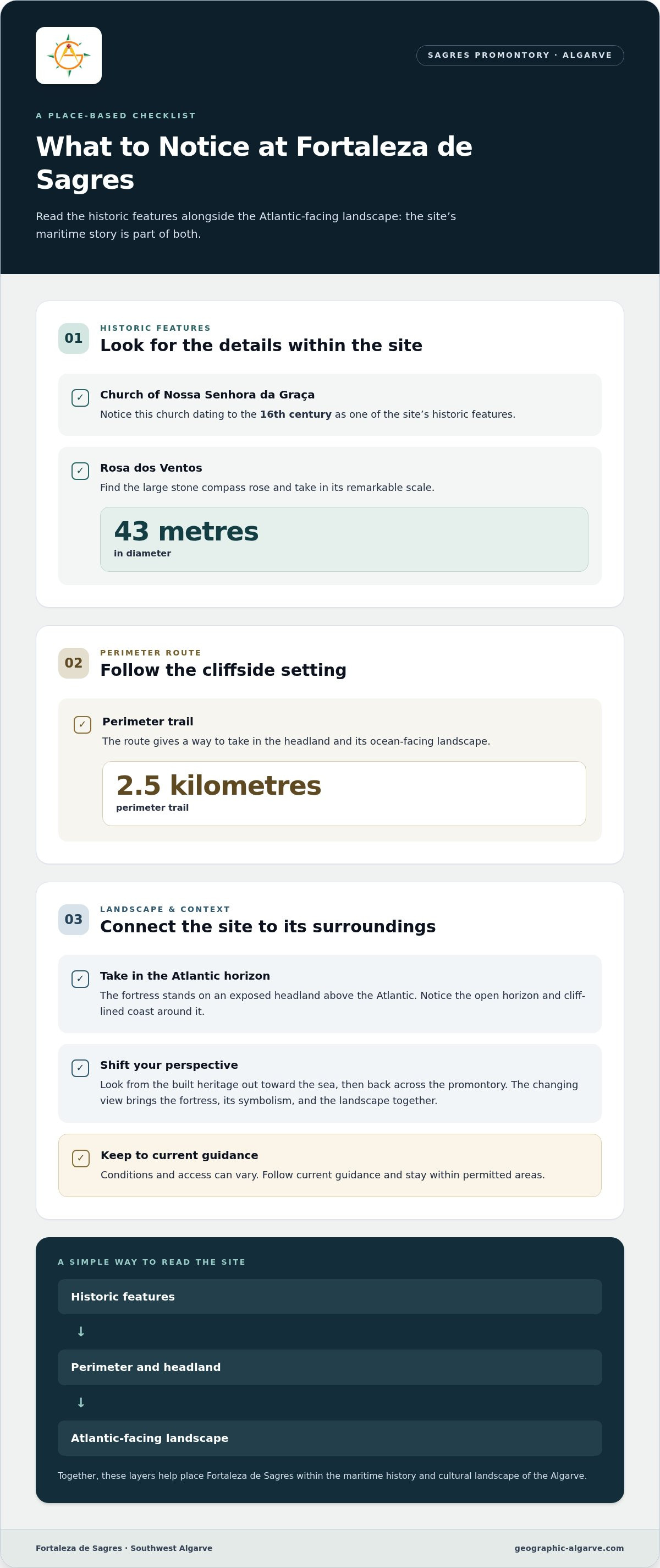
At Fortaleza de Sagres, take in the setting as well as the historic features. The site stands on an exposed headland above the Atlantic, where the open horizon and cliff-lined coast put its maritime past into context. Look from the built heritage out toward the sea, then back across the promontory. This change in perspective shows how closely the fortress, its symbolism, and the surrounding landscape are connected.
Notice the landscape and Atlantic setting
Pause to observe the coastline and the scale of the ocean around the headland. Consider how the site’s position would have shaped its relationship with navigation and the maritime world. Conditions and access can vary, so follow current guidance and stay within permitted areas.
Explore cultural and natural heritage together
Inside the historic site, look for the Church of Nossa Senhora da Graça, dating to the 16th century, and the Rosa dos Ventos, a large stone compass rose measuring 43 metres in diameter. The 2.5-kilometre perimeter trail offers a way to experience the fortress alongside its cliffside landscape. The official site also highlights local flora and fauna. Notice the natural heritage as well as the architecture, without assuming that any particular species will be visible.
Use this short checklist to explore attentively:
- Look outward: Notice how the Atlantic-facing coastline frames the historic site.
- Look closely: Take in the church and compass rose as distinct features with different roles in the landscape.
- Look for connections: Consider how the built heritage, open headland, and natural environment shape one another.
- Observe with care: Pay attention to the flora and fauna without disturbing the site or assuming what you’ll encounter.
There’s no need to rush from one feature to the next. Let the relationship between the fortress and the promontory guide your visit, and use the site’s current information to plan around access. This turns the visit into more than a checklist of landmarks: it helps you read Sagres as a place where cultural heritage and Atlantic nature remain closely connected.
How to Plan a Fortaleza de Sagres Visit in 2026
A rewarding visit starts with a quick check, not a packed schedule. First, confirm the latest official access information. Then decide which features matter most to you and leave time to take in the wider promontory. Opening arrangements, admission details, and cultural events can change, so consult the official fortress website before setting out.
What to check before setting out
Check the official information close to your visit date. Review opening hours, admission details, temporary access notices, and event announcements. Older pages and past visit reports may not reflect current arrangements. If you’re planning around an event, verify its date and read any visitor guidance provided with the announcement.
Also review local conditions and follow signs and staff guidance on site. The fortress occupies an exposed Atlantic headland, so conditions can affect how you experience the outdoor areas. Don’t assume every area or path will be accessible on the day. A little preparation helps you arrive with a realistic plan while leaving room to adapt.
How to make the visit more meaningful
Choose a few things to notice rather than trying to rush through every feature. You might focus on the fortress’s history, the relationship between the built site and the coast, or the natural heritage highlighted by the official site. As you explore, look beyond the walls and consider how the broad promontory adds context to the maritime story.
Keep your plan flexible. Allow time to pause, observe the landscape, and read any information available on site. If cultural programming is part of your visit, check event details beforehand and plan around them. This balance of preparation and open-ended exploration can make the visit more meaningful than a quick stop for photographs.
For wider regional context, a Southwest Coast Portugal tour guide can help you consider Sagres alongside the surrounding coastal heritage. Geographic Algarve’s Southwest Coast, Lagos & Sagres Tour offers a locally guided way to connect the fortress with the broader region. Explore the Southwest Coast, Lagos & Sagres Tour and discover more of the Algarve’s cultural and natural landscape.
Fortaleza de Sagres on the Algarve's Southwest Coast
A visit to Fortaleza de Sagres can be a meaningful stop on its own, while the wider Southwest Coast adds context. The fortress belongs to a landscape shaped by maritime history, local traditions, and the Atlantic environment. Exploring the region around Sagres helps connect these themes and shows how cultural heritage and nature are part of the same coastal story.
Why local interpretation adds context
Local knowledge can connect what you see at the fortress with the character of the surrounding coast. A guide can explain how maritime memory, cultural traditions, and the landscape relate, while drawing attention to the region’s environmental heritage. This goes beyond listing landmarks: it offers a way to understand Sagres as part of a living region, not an isolated historic site.
Geographic Algarve was founded by local expert Vasco Salgueiro and brings more than 25 years of experience to its cultural and nature-based experiences. Its multilingual local guides focus on cultural heritage, local traditions, and environmental understanding. That local perspective is especially relevant in a place where history, stories, and the natural setting are closely intertwined.
Make Sagres part of a wider coastal discovery
Think of the fortress as one point in a broader Southwest Coast experience. Exploring the region gives you a wider sense of its heritage and landscapes, while leaving room to appreciate Sagres in its own right. Geographic Algarve’s Southwest Coast, Lagos & Sagres Tour brings local interpretation to this regional story.
The tour connects the fortress to a wider coastal perspective without reducing the visit to a checklist of stops. Bring your curiosity about history, cultural memory, and the natural environment, and let the regional story unfold around them.
Ready to discover more of the Algarve’s Southwest Coast? Explore Geographic Algarve’s Southwest Coast, Lagos & Sagres Tour and experience Sagres as part of the region’s broader cultural and natural heritage.
Make Your Southwest Coast Visit Count
Fortaleza de Sagres is more than a historic fortification: it’s a place where maritime heritage, cultural memory, and the Atlantic landscape come together. Distinguish the fortress from the wider Sagres Promontory and nearby Cape St Vincent, then take time to notice the site’s historic features and natural setting. Before you go, check official visitor information for current opening arrangements, admission details, and events.
To see Sagres as part of a wider regional story, explore it with local interpretation. Geographic Algarve was founded by local expert Vasco Salgueiro and brings more than 25 years of experience to cultural and nature-based experiences. Its multilingual local guides connect the coast’s heritage, traditions, and environment. Let Fortaleza de Sagres be the beginning of a deeper Southwest Coast discovery. Discover the Southwest Coast, Lagos & Sagres Tour.
Frequently Asked Questions
What is Fortaleza de Sagres famous for?
Fortaleza de Sagres is known for its connection to Portugal’s maritime history and its position above the Atlantic. Established under Prince Henry the Navigator in the 15th century, the fortress became part of the cultural memory of the Age of Discovery. The wider promontory also carries ancient traditions and symbolic associations, while the surviving site reflects centuries of change. It received the European Heritage Label in 2015.
Is Fortaleza de Sagres the same place as Cape St Vincent?
No. Fortaleza de Sagres is a historic site on the Sagres Promontory, while Cape St Vincent is a separate nearby landmark, about 6 km away. Cape St Vincent, also called Cabo de São Vicente, marks the southwesternmost point of mainland Europe. The fortress and cape are often included in the same regional visit, but they are distinct places with different histories and landscapes.
Is Fortaleza de Sagres worth visiting?
Yes, especially if you’re interested in maritime history, cultural heritage, or Atlantic landscapes. A visit brings together historic features and the exposed coastal setting that shaped Sagres’s symbolism. Explore the fortress, consider its relationship to the surrounding promontory, and take time to notice the natural environment. It’s a rewarding stop if you want more than a quick coastal viewpoint.
How long do you need to visit Fortaleza de Sagres?
Allow around one to two hours for Fortaleza de Sagres, depending on how much time you want to spend exploring. The perimeter walk alone takes approximately 45 minutes to one hour, according to current visitor information. Add time to pause at historic features, take in the Atlantic-facing landscape, or explore at an unhurried pace. Check current access details before planning your day.
What can you see at Fortaleza de Sagres?
Highlights include the 16th-century Church of Nossa Senhora da Graça and the Rosa dos Ventos, a large stone compass rose measuring 43 metres in diameter. You can also explore the perimeter trail along the cliffs and see how the fortress sits within the Atlantic landscape. The official site highlights local flora and fauna, too, so take in the natural setting as part of the heritage experience.
What is the best time to visit Fortaleza de Sagres?
There isn’t one best time for everyone. Choose a date that suits your Algarve plans, then check the fortress’s official opening hours, admission information, and temporary notices before setting out. Seasonal arrangements may differ, and event information can affect your plans. The site is on an exposed coastal headland, so review current local conditions and follow the guidance provided on the day.
Can you visit Fortaleza de Sagres with a local guide?
Yes. Geographic Algarve’s Southwest Coast, Lagos & Sagres Tour offers a guided way to place Sagres within the wider region. Founded by local expert Vasco Salgueiro, the company has more than 25 years of experience and multilingual local guides focused on cultural and natural heritage. Geographic Algarve serves Algarve destinations including Portimão, Lagos, Albufeira, Silves, Lagoa, Carvoeiro, Alvor, Armação de Pêra, Galé, Olhos d’Água, and Praia da Luz.

Article by
Kim
To conclude her studies Tourism and Recreation Management, Kim came to Portugal in 2006 for a three month internship and then simply never left! She took a few years exploring the country, living in Porto and the Algarve, while gaining experience working for the main international tour operators. Since 2013 she is a full-time local guide for Geographic Algarve, where she can share her love for and knowledge of Portugal in the best way. Both on tour and here in the blog, she shares crucial tips to get the most out of your stay in the Algarve. Kim creates her articles and photos with the help of AI, so she has more time left to show you around in the wonderful Algarve!
Disclaimer - AI generated content
This article was created by AI (including photos), within guidelines set by Geographic Algarve. Geographic Algarve checks to the best of her abilities all articles for incongruencies, but may not succeed to correct all inaccurate details before publishing. In no way or form, are these articles part of any contract when booking one of our trips. Only the specific tour information as stated on www.geographic-algarve.com is valid. In case of any doubt, please contact us via [email protected].


